 How we use AI in our process

Combining AI and Usability:
Solving Key Design Challenges
Simplifying Artificial Intelligence Complexity
AI-supported products help tackle complex tasks such as processing vast amounts of data and automating repetitive workflows. Yet, how outputs are translated and demonstrated to the end user is not always easy to grasp. We solve this challenge.

Improving Adaptation and Transparency
Business owners find it challenging to make critical decisions based on the results generated by AI. Their main concern is the lack of clarity and transparency. Our approach to designing AI products is to craft explainable interfaces and dashboards.
Increasing Trust in AI Solutions
As AI technologies evolve, there is a certain skepticism about trusting them. Our AI design studio aims to reveal the whole mystery to you, and we do that by adding elements to the interface, such as contextual insights, confidence scores, and feedback mechanisms.
Check what our clients say about working with Uitop


Cole Weiler
CEO, BoltWise“They took way more responsibility than we asked and we were so happy with the results of all their work. Uitop was easy to work with, flexible, and valuable to our company.”


Neil Hosey
ResHub, CTO


Dylan Gambardella
Founder, Different Health“They took extra time to ensure that our frontend developer could easily implement the wireframes.”

Sam Jordan
TrovBase, CEO

Dirk Pauw
CEO, Tavas“We’re most impressed with Uitop’s ability to come up with a system to be able to bring design solutions.”

Jordan Girard
Whiterock, Founder

Jake Heimark
Costa Security, CEO"We are happy with the improved UI/UX, which has made product navigation cleaner, simpler, and more intuitive. The team is great and always there to help."

Michael Mosseri
Total Brokerage, CEO

Nicolas Endress
ClimEase, CEOAI Design Case Studies

Designing Reliable AI Copilots
Copilot should feel like part of the team, especially when it’s built for doctors, like we did with Sully. That’s why we focused on creating a seamless user experience that actually helps users instead of getting in their way. The results are high adoption rates and a successful Series A. That’s what great UI/UX can do.
View case
Turning Data into Clear Predictions with AI
Every SaaS product should bring real value to its users. By integrating predictive UX, we made working with data way more efficient and organized. Users no longer have to calculate trends as the AI handles that for them. The interface steps in with helpful reports, smart hints, and guidance so users can just focus on making better decisions.
View case
AI Prioritization with Automated Ranking
We designed a feature that places ranks for incoming orders by urgency, value, and delivery data using artificial intelligence. Now users don't manually sort through a long list because they can see the most critical orders highlighted at the top of the list. This helped our client's customers reduce decision-making time by 43% and increase supply chain efficiency.
View caseReady to redesign your product?
A great product is the one designed with the client’s business goals in mind!

Why Choose Us?


User-Centered AI Research
Understanding Your User
What we find working for us doesn’t always apply to the users. Thus, our first step in creating UX design for AI services is understanding the user. The expectations and mental models differ from one person to another. And advanced technology is perceived by everyone variably. That is why we conduct surveys, interviews, usability tests, and other research methods to gain meaningful insights into what users want to achieve with the product, how they expect to interact with it, and what pain points they face.
Mapping User Journeys for AI-driven Interactions
After preliminary research, we proceed to understand the holistic experience from the first interaction to ongoing product use. For that purpose, we track how users move on the platform, their actions, in what order, where they stop, and where they encounter bottlenecks. This information is used to create user journey maps, visual presentations of the processes users went through to reach the goal.

Designing for Explainability & Trust
Transparent AI Feedback Mechanisms
Building trust with customers is difficult as it takes one more mistake to ruin the relationship. However, with AI, it becomes twice as difficult as users hesitate to rely solely on advanced technology decisions. We understand this concern, and when we create UI/UX for AI, we design interfaces that have clear and transparent feedback mechanisms. That way, users can see why and how the outcome was achieved.
Ethical and Bias-Aware Design Considerations
When AI is trained on certain biased data, the mechanisms can inherit those inconsistencies and show them as successful outcomes. Our priority is to reflect those biases in design. We craft interfaces that clarify when inaccuracies and social and ethical biases might have influenced the decision.

Interaction & Interface Design
Conversational UI (Chatbots, Voice Interfaces)
Conversational interfaces such as chatbots or voice assistants serve as a direct channel of communication with AI technologies. They mimic conversation, offering a way to interact with the platform. Our AI design agency focuses on crafting user-friendly conversations UIs that feel like communication with real support agents. Through voice commands or a chatbot, people can receive answers within the context, making the interaction close to a human one.
Adaptive UI for AI Personalization
Advanced personalization is one of the breakthrough features AI offers. We leverage its potential and create adaptive UIs tailored to user choices and previous experiences, providing personalized content, suggestions, and notifications. For instance, adaptive UI would show shoppers product recommendations based on previous searches for a shopping app.
Data Visualization for AI-Driven Insights
With AI, businesses can comprehensively analyze tons of data within seconds. However, the critical factor here is the ability to translate that information. In artificial intelligence product design, we work on data visualization with clarity and simplicity in mind. Our goal is to make interactive visualizations that make it easy for users to digest the insights.

Prototyping & Validation
Usability Testing with Real Users
How do we make sure that AI product design is user-centered and easy to navigate? We test interactive prototypes on real users. Once design concepts are ready, we invite actual users to take part in usability testing. Then, we gather feedback, analyze friction points, look at confusing places, and implement improvements before launch.
AI Model-Human Interaction Evaluation
The final stage is to make sure people easily interact with AI technologies. We observe how users interact with the product and whether they communicate efficiently. Based on the outcomes, we decide where AI responses can be clearer and more tailored to user requests.


Step-by-step process
Building AI UI/UX design requires following a user-centered approach. We ensure that AI services are highly functional and easily comprehensible for end users. By working on user research, prototyping, testing, and refinement, we build interfaces people can easily understand and trust.
Discovery and Research
Ideation and Prototyping
Usability Testing and Iteration
Visual Design and Development
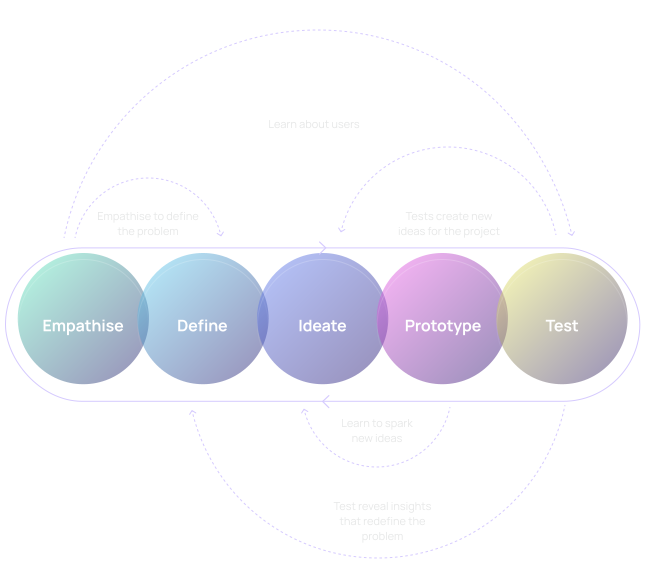
Tools and apps for design and testing
Our agency relies on a diverse toolkit including Figma for interface design, Sketch for crafting UI, and Adobe Creative Cloud apps like Photoshop and Illustrator for custom graphics. We also leverage accessibility testing tools to evaluate WCAG 2.1 compliance.


Ready to redesign your product?
A great product is the one designed with the client’s business goals in mind!
Frequently asked questions and answers
01/ What is UI/UX design for AI-powered products?
It is a process of building easy-to-understand interfaces for AI and machine learning technologies.
02/ Why care about design in AI?
AI is a complex field that has immense potential. However, only clear and transparent data visualization helps to provide meaningful interaction.
03/ What are the steps to achieve clear AI design?
Designers go through multiple steps before submitting a final version for production: user research, prototyping, testing, and designing.
04/ Do all UI/UX design studios specialize in AI product design?
To approach AI challenges, a talented and experienced team is needed. Not every digital design studio works in such a demanding field. But our agency has a proven track record of delivering the best solutions for AI services.