
Design, Product • Feb 19, 2026
 How we use AI in our process Learn more
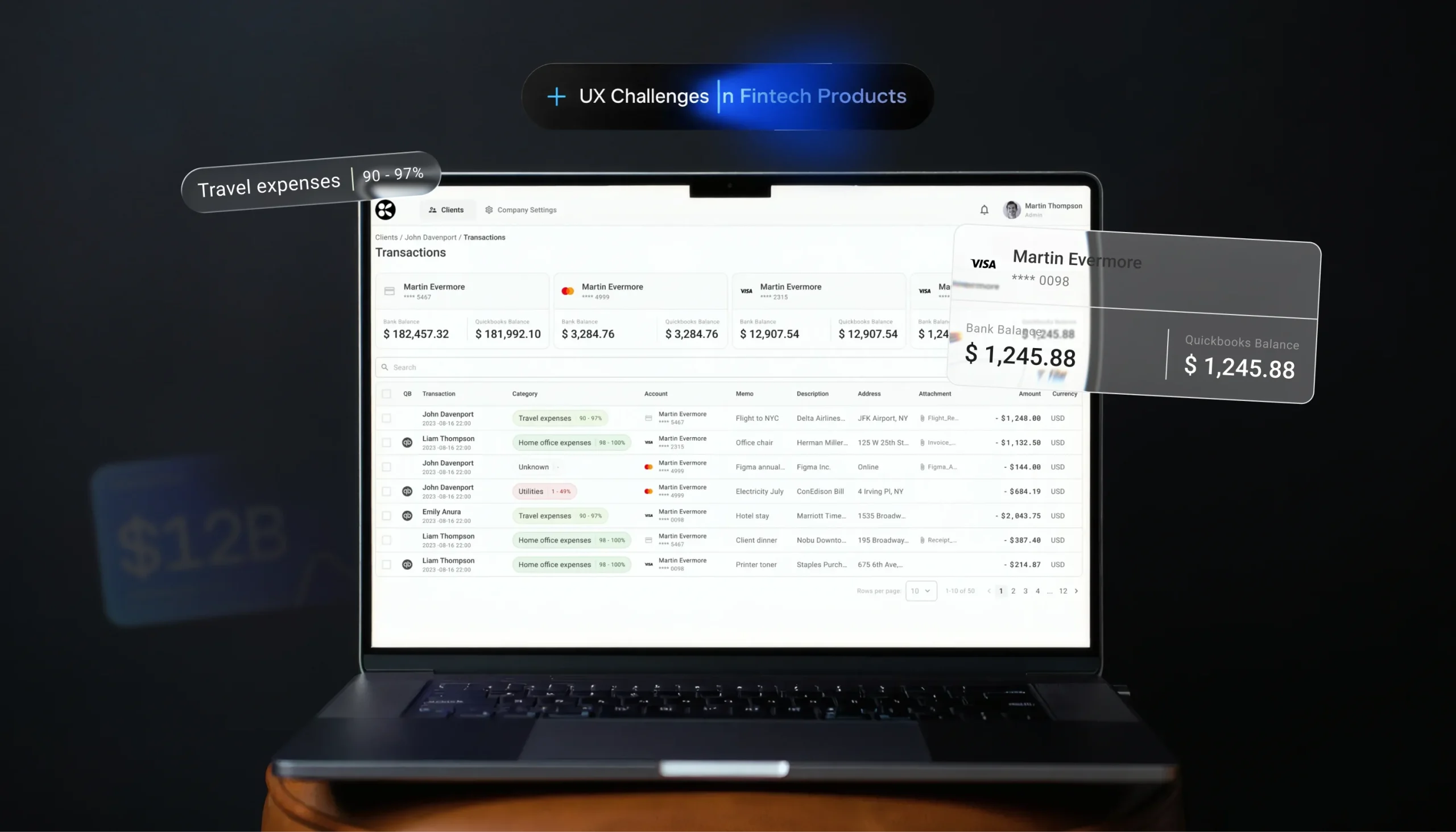
The applications in fintech services handle finance, sensitive information, and intricate, heavily regulated processes, so the users expect these applications to be secure, transparent, and reliable. They anticipate a high level of usability, so a single misstep in user experience can undermine credibility and optimization in a very short time.
Creating fintech applications is not just a matter of usability; there is a need to strike a delicate balance between usability, compliance, and trust. This article discusses the major UX challenges in fintech, along with the corresponding solutions.
UX in fintech is unlike other digital applications because it directly handles real money and highly sensitive personal data while operating under strict regulatory frameworks. User confidence remains fragile in this environment, since even a minor design or usability error can undermine credibility, reduce adoption, and create long-term consequences for the product.
Legal and regulatory guidelines inform almost all aspects of fintech UX design. It is compulsory to follow regulations related to KYC (Know Your Customer) and AML (Anti-Money Laundering). UX patterns for onboarding users in fintech apps must be adapted carefully, as even a slight mistake can lead to litigation.
However, financial risk also affects user expectations in other ways. For example, users are naturally risk-averse when dealing with money in an online environment. They expect transparency, predictability, and unambiguous confirmation of their actions.
Additionally, there is sensitive data that adds another dimension of complexity. With fintech apps, there is a need to ensure the security of personal and financial data at every touchpoint. There is thus the need for designers to make security efforts transparent without making users feel confused or overwhelmed.
These factors make fintech UX unique, and it is not a situation where standard patterns are adequate, so specialized strategies must be adopted. Successful fintech products combine compliance, security, and trust deeply into every aspect, from onboarding through transactions. Predictable interactions, unambiguous communications, and clear guidance help people feel secure, safe, and confident.


Fintech products have their own set of challenges in the domain of product UX, and this has a major impact on the overall success of user acquisition, retention, and conversion. Unlike normal applications, fintech comes with the added responsibility of dealing with money and sensitive user information, and regulators are very particular in this sphere.
Despite their specific focus, consumers expect security, transparency, and consistent workflows, which puts pressure on even specialized solutions like interior design accounting software.
The most common UX complications facing fintech are:
These issues are related, e.g., tightened verification improves compliance but may weaken conversion. Overloaded interfaces affect trust, even when security is tightened.
With trust, security, compliance, and scalability as core values, fintech products can sustain high conversion rates without compromising user confidence. Getting these core issues right is the starting point in achieving fintech design success.
Trust sits at the core of any fintech product, shaping how users feel about the safety of their money and personal data. If an application fails to communicate strong and reliable security through its design, users may abandon it even when the underlying technology itself remains secure.
Building that trust involves UX at each step of the journey. Consistent reassurance from every interaction will help make them believe that their actions are secure and predictable. This means transparency: the fees being taken, explanation of verification steps, transaction process explanation - each stage needs to be shown directly to foster that relationship. Hiding steps in a process or having unclear messaging creates doubt and reduces confidence.
People expect strong safeguards, but they want them to work quietly rather than interrupt every action. Examples:
Providing feedback on each step also helps build trust. The status of a transaction, changes done on an account, or a verification process should be immediately visible to the user. Progress indicators and confirmation messages, as well as error messages, ensure this.
Explanatory actions are equally important. So, when users are faced with security questions or security features, the application can explain the necessity of those security questions or features to the users. For example, if there is an issue with the verification of the payment, the application can explain the reason to the user.
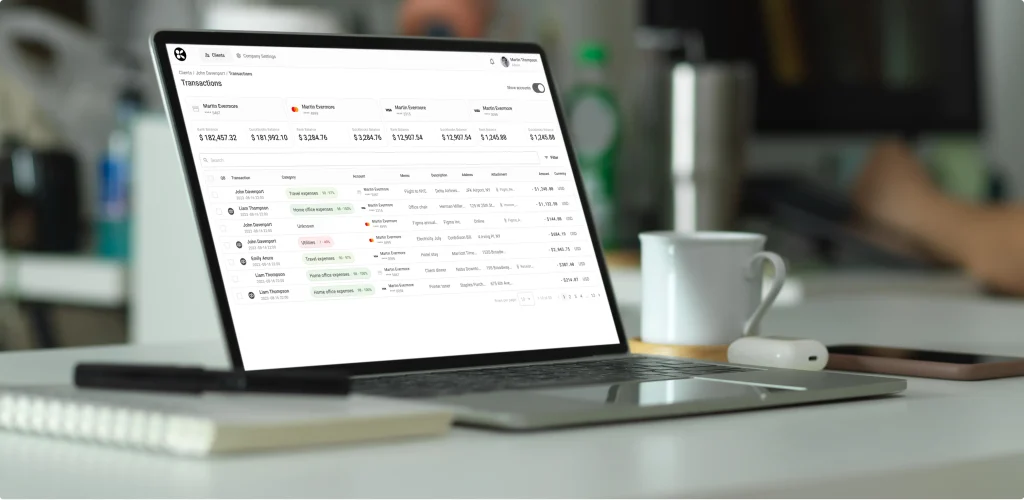
A good example of the implementation of this is one of our clients’ projects - Pacioli - accounting software for the medical field. There, accuracy and transparency were not to be compromised. Professionals working with financial data needed to interpret numbers with confidence, instead of merely accepting what the system displayed.
We designed the interface in such a way that any screen could be printed out and used as a report. Layouts stayed logical and readable. When financial data appears structured and explainable, users do not rely on blind trust; clarity itself builds credibility.
Besides, compliance needs the same careful balance. KYC and AML checks remain essential, yet poor timing or heavy-handed execution can disrupt the user journey and cause unnecessary friction. By performing these procedures in several tiny steps and providing context and progress indicators, UX designers can enhance the user flow.
Good fintech UX design enables trust, security, and compliance in each stage of the experience. Clear flows, confirmation, and communication of security features transform security into a confidence-building user experience.
Certain UX patterns naturally enhance trust in fintech products:
Predictable flows increase user confidence. Consistent button placement, uniform interaction patterns, and clear navigation make outcomes easy to anticipate. Visual cues such as icons, colors, and animations reinforce reliability.
Onboarding happens to be one of the most vulnerable areas when considering UX design for fintech. Poorly designed flows might lead to drop-offs, undermine users’ trust, and damage conversion rates.
Although verification steps are necessary for compliance, they can become burdensome if they feel long, unclear, or opaque, leading users to abandon the process. Reducing friction requires splitting complex checks into smaller steps, offering clear guidance throughout, and visibly showing progress to keep users engaged.
| Step | UX risk | Design solution |
|---|---|---|
| Identity verification | Friction, drop-offs | Use smart scanning, minimal input fields |
| Account setup | Confusion, errors | Provide guided, step-by-step instructions |
| Security setup (password, MFA) | Overwhelm, frustration | Explain the purpose and keep the steps simple |
| Funding account | Hesitation, trust issues | Show transparent instructions and progress |
| Document upload & verification | Delays, uncertainty | Provide real-time feedback and clear status |
Multi-step onboarding can be tedious, but UX patterns help maintain trust and completion rates:
Ensure fluid flows are predictable and transparent to help users feel in control of the interaction. Features such as checkmarks, green highlights, and simple icons ensure a sense of accomplishment at each step of the interaction. Good messaging can help alleviate users’ anxiety as they work towards completing the task.
With the consideration of conversion and compliance, it becomes possible for fintech apps to strike the right balance in verification. Onboarding becomes a confidence-building process.

In the financial technology industry, there are several products that utilize different roles such as admin, managers, and ordinary users. This creates a complex scenario since, for instance, when a user logs in, they should be able to know what actions to perform and which they can’t perform.
Managing multiple user roles adds complexity to UX design, as interfaces must clearly separate permissions, workflows, and access levels while still feeling intuitive for every type of user:
In addition to this, poorly implemented permissions can also influence other integrations. Fintech products usually interact with various services, such as a CRM or internal management systems. Effective UX design for fintech leads to easier interaction, making it less difficult to distinguish between different systems. For instance, a fintech product might be required to integrate with a CRM. Proper role and permission management can allow a business to develop a custom CRM based on user interface requirements while maintaining security.

If errors occur in the design of the permissions system, it may reduce user confidence and lead to errors. Some of the common permission design errors are:
Such errors weaken user confidence, as the system can appear unreliable or unsafe. Consistent access rules, clear role boundaries, and visible safeguards support credibility, while precise labels and contextual interface cues reduce confusion and reinforce confidence.
Well-defined role-based flows ensure that only relevant information is displayed to the user, which in turn reduces confusion, enhances usability, and adds stability for the user as well as the administrator.
New challenges accompany scaling a fintech product. More users equate to more transactions, which can translate to an increase in the number of user roles. It also reflects the reliability component, which needs to be considered. What worked with more users might not necessarily work.
An increase in scale can lead to an increase in UX risks, where more users could experience confusing interactions, slow user experiences, or unclear feedback mechanisms. Multi-step interactions, complex dashboards, or permissions-related issues could compromise user experiences when not properly planned.
Solutions offered in UX are of critical importance to ensure that the user experience remains seamless at larger scales. In this regard, the design considerations strive to offer a highly predictable experience, ensuring a certain consistency in terms of design as well as feedback mechanisms. Predictability is essential to ensure users understand the outcome of the experience.
Key scalable fintech UX strategies include:
One of the main features of scalable UX is that it goes hand in hand with technical scalability. A frontend design should go in line with the backend architecture to ensure that performance stays smooth while the product is being developed. Predictable and reliable flows reduce the risk of errors and maintain user trust over time.
Early UX integration lays the groundwork for long-term growth, ensuring that compliance, security, and usability remain stable as the platform expands. Fintech products built with scale in mind achieve stronger adoption, higher conversion, and lasting user confidence.
To build a product that grows seamlessly, consider scalable web application development services to ensure your UX and technical architecture scale together.
Consumers anticipate transparency, consistency, and obvious security when managing their money; even little UX errors in fintech may swiftly undermine user confidence and have a direct impact on conversion rates. The influence is almost immediately apparent when the experience is ambiguous or inconsistent.
Interface overload, where fintech products try to display too much information at once, is a common problem. Dashboards packed with charts, buttons, alerts, and notifications overwhelm users, making it harder to identify key actions and increasing the likelihood of hesitation or errors.
Hidden logic, in which the causes of successful or unsuccessful acts are not readily apparent, is another prevalent issue. Unexpected limitations, slow replies, or mysterious fees can make users feel powerless, which erodes confidence and casts doubt on the platform's dependability.
Mistakes made during UX design will affect your reputation. Unclear messages or a lack of information in error messages will confuse users. All issues, even trivial ones regarding incorrect validation, lead to poor designs of forms, and users abandon onboarding or transactions.
Other subtle issues include inconsistent navigation, poorly labeled actions, and unclear progress indicators, all of which make it harder for users to move through multi-step processes with confidence. Fintech products rely on predictable flows that clearly signal what comes next and why. When navigation or feedback feels uncertain, user confidence drops, engagement weakens, and hesitation replaces trust.
The interfaces need to be neat and clean, logically structured, focusing on users’ goals. Critical actions should be clearly explained, with immediate feedback and status indicated. Sending visual cues, adopting consistent patterns, and guiding in steps enables the user to feel in control.
UX excellence is inextricably linked to conversion and trust in fintech. Reliability is strengthened, and users are encouraged to finish tasks with confidence when overloaded interfaces, hidden logic, and errors are avoided. Careful design transforms possible points of contention into chances to increase self-assurance and contentment.
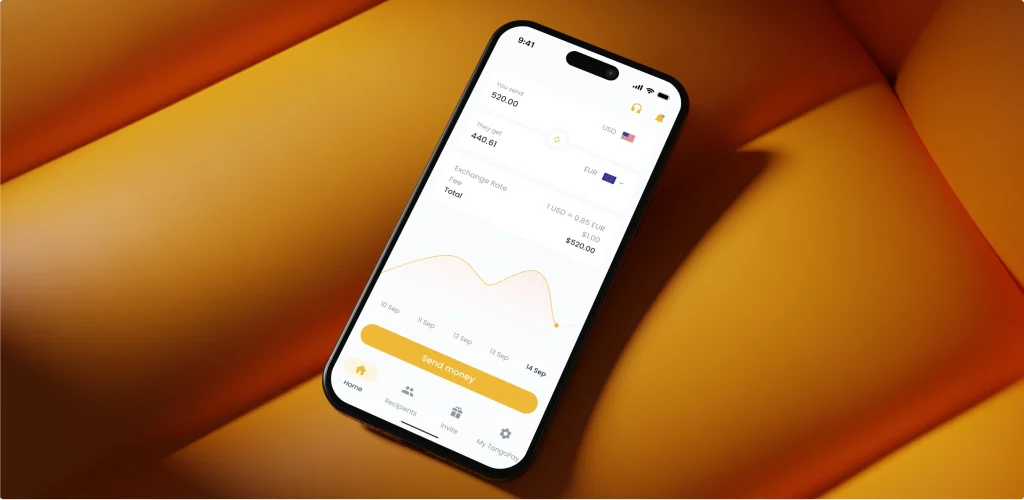
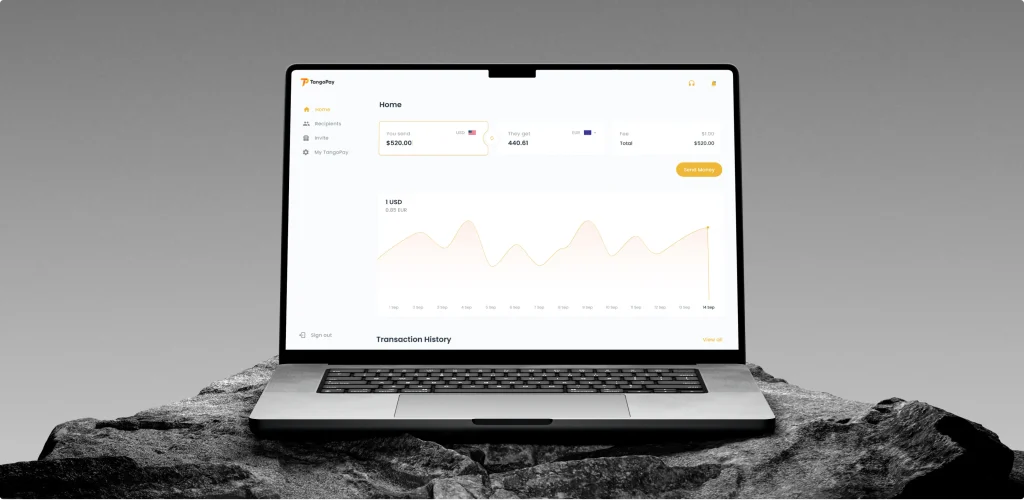
Designing fintech products requires specialized knowledge beyond general UX principles. Off-the-shelf usability techniques will help clean up the UI, but they can’t impart understanding of a nuanced, heavily regulated financial system. Fintech products need to balance usability with legal compliance, robust security, and real-world financial workflows - areas where universal UX solutions tend to come up short.A strong example of this is TangoPay, a platform for money transfer across the world. Our team redesigned its interface to balance complexity with simplicity. The result was that the platform reached a design-to-code success rate of 97%, delivered over 350 screens, and launched within four months. Final metrics indicated a 96% ease-of-use score and a 92% increase in user retention post-launch, which showcases a UX design that deeply respects financial logic and user behavior.
The special requirements for fintech product design include:
Designers without experience in the field of fintech often create overly simplistic systems, while others may be too complex for users to manage effectively within the financial services sector.
A UX specialization in fintech helps bring design, development, and compliance teams together to develop products that can scale well and increase user adoption over time.
User Experience is the basis for gaining customer trust in Fintech companies. Attaining predictable and certain flows of understanding in finance, which are transparent in nature, is a big basis for gaining customer trust and effective use of the same.
UX design for fintech also plays a role in the adoption by facilitating the smooth progress of the users as they go through the onboarding and verification process. UX plays a part in retention by ensuring that the processes are not cumbersome and frustrating, especially for the users. UX also plays a part in scaling by offering predictable and reliable processes.
For businesses falling under the fintech industry, having an effective UX goes beyond aesthetics and represents an essential and strategic component that establishes brand reliability and fosters conversion, as well as user loyalty. Indeed, by working with experts in fintech UX design, businesses can easily develop high-quality products that meet standards, whether for growth or otherwise.
From a user’s point of view, good UX design can provide users with the confidence and security needed while managing their finances.
Breaking down an overall process into smaller parts, tracking progress, and providing context have been seen to help.
Overloaded screens, hard-to-follow instructions, hard-to-perceive actions, and confusing feedback can lead to user confusion and mistrust.
Predictable flow, confirmable interactions, and navigability will instill a sense of comfort and assurance, prompting the user to return frequently.
Yes. UX can convey verification steps, security measures, and regulatory requirements in a way that can be understood by the user.