Design, Product • Nov 16, 2023
 How we use AI in our process Learn more

In the modern development process, many terms intersect with each other. One of the spheres that frequently leads to confusion is design, where people often ask:
Is product design and UX design same?
Although both share common aspects, they focus on different parts of the product creation. Understanding and properly using those elements is the key to a successful solution that functions properly and delivers a valuable experience to the users.
User experience is centered around the perception of your product by the end customer. Its primary focus includes accessibility, usability, and features that will make the whole experience of the product enjoyable and seamless. The primary activities of the UX design include the following:
The ultimate goal of UX design is the creation and delivery of a user-friendly journey that leaves your customers happy.
Unlike the UX specialist, the product designer focuses on the strategic vision of the whole product, which goes far beyond the user experience. Therefore, product design and UX together become a powerful combination that ensures that the product is not only enjoyable for the customers but also serves specific business goals. To understand the role of product design, let's take a look at some of its core activities:
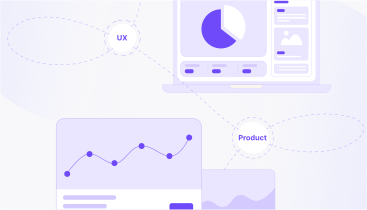
When answering the discussion of the UX designer vs a product designer, it's important to distinguish those roles properly, even though they frequently overlap.
| ASPECT | UX DESIGN | PRODUCT DESIGN |
| Focus | UX design roles mainly focus on the satisfaction of the users' needs and expectations | Product design lies in the holistic product vision and business needs |
| Scope | Scope focuses on the smooth interactions, usability, and users' flows | Scope involves global strategy, scalability, and feature prioritization |
| Deliverables | UX designers' work focuses on the delivery of the prototypes, wireframes, and user flows to illustrate how the app interacts with users | Product designers are creating product roadmaps, guiding development, and ensuring consistency in every part of the product |
| Role in team | The role of a UX designer is more execution focused, while its global focus is mostly tactical | The product designer role can be considered more strategic, since it's mostly engaged in ensuring long-term success |
Even though the UX and product design serve different purposes, their roles frequently intersect in various essential aspects.
Both areas require exceptional levels of design thinking, which include experience in problem-solving, creativity, and thoughtful planning. Moreover, each sphere heavily relies on careful research, meticulous testing, and frequent iteration. Thereby, the received data is applied differently by each specialist: UX designers conduct usability tests to refine interactions, while product designers use insights to prioritize business plans.
Knowing when to involve a UX or product designer is crucial when it comes to the user research, the choice of tools, and overall product success. It's also necessary to put a clear distinction between those roles when defining development responsibilities and assigning tasks, which should be based on their difference.
You will typically need your UX designer to be present during the workflow improvement, feature testing, or usability optimization. Their main line of work is to understand users' behavior, refine interactions, and conduct research to ensure that the end product is intuitive and efficient.
As for the product designers, they are irreplaceable when it comes to the creation from scratch or scaling the existing products. They do not handle the implementation of features, but are looking deeper into the implementation of long-term business strategies. Product designers are responsible for the delivery of the business strategy that will bring your product to the top of the charts.
Real-world examples are one of the best ways to dot all i's in terms of differences between the UX and product designers. Both roles are essential, yet they approach the challenge of the product creation from different perspectives: first, through usability and interaction, and second, via scalability and strategy.
Imagine a startup that launches from scratch. In this scenario, the UX designer's responsibility is to streamline the workflows, design features so that products feel easy-to-use and intuitive. At the same time, a product designer will be engaged in shaping the roadmap, aligning business goals, and contributing to the creation of monetization and scaling strategies. The good news is that in Uitop, we have experience in both areas, and here are some of our success stories.
In the ResHub case, our team was entirely responsible for the complete UX design of the medical staff planning platform. Throughout the process, our specialists conducted full-scale user research, developed wireframes, built prototypes, and ensured that the whole product had an understandable and clear structure.

Then came the long process of building the prototypes. As a result of this continuous process, we managed to refine the scheduling, dashboards, and reporting, leading to increased usability and a boost in user engagement.
In the Slabstack ERP, a platform for the construction industry, our UI/UX agency was entirely focused on product design. In this case, our crew went far beyond the tactical design implementation and handled the overall definition of the product vision.

Our team also implemented the modular design system that allowed us to maintain consistency among all product elements and features. Our product designers also made sure that all of the developed features were aligned with both business and audience needs. As a result, the final product achieved high engagement levels, strong usability, and alignment with the business requirements.
The differences in product and UX design lie in focus, outcomes, and scope of work. While product design aligns business strategy and general vision, UX design is engaged in the tactical tasks, like the overall user experience or feature implementation. However, to receive a truly unique and effective app, you have to make those design elements function seamlessly. Ready to boost your product? Schedule a call to increase your UX and establish a long-term product design strategy.