 How we use AI in our process

Startup, Development
/
Apr 08, 2026

Every SaaS product starts as an MVP. But an MVP is the starting point. The decisions you make at launch shape everything that follows. Architecture, UX, component logic - all of it compounds over time. Therefore, scalable SaaS product design begins on day one.
The stakes are real. Most SaaS products that struggle to scale often fail because of structural decisions made too early and never revisited. Understanding this connection is what separates product teams that grow sustainably from those that rebuild constantly.


Need to develop a SaaS product?
We help teams build MVPs focused on validation, speed, and real user feedback
Contact usThe path from MVP to scalable product is a sequence of decisions. Some of them open doors. Others close them permanently.
When teams rush through MVP design, they create fragile foundations. A poorly structured navigation pattern becomes technical debt, an inconsistent component library becomes a redesign project, and a hardcoded user flow becomes a bottleneck at 10x users.
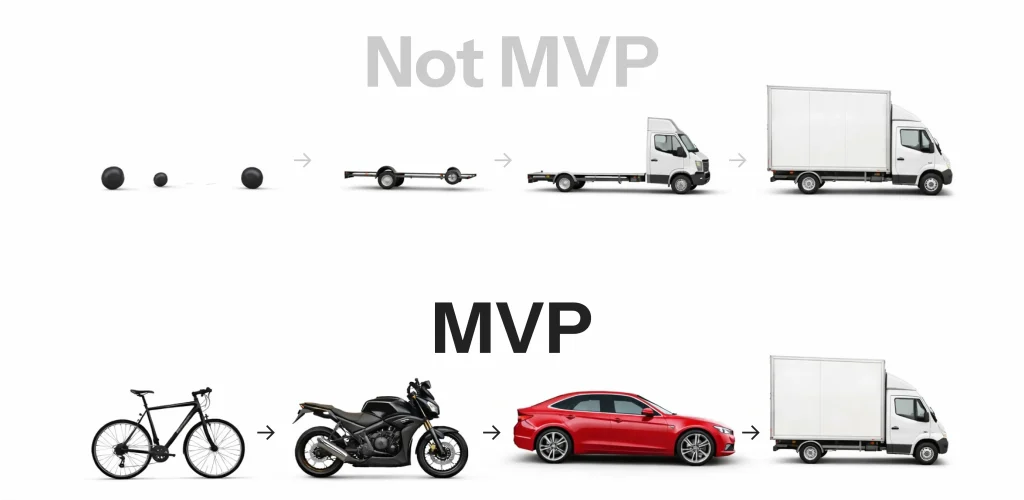
There is a common misconception that scalability is a problem you solve later. In reality, it is a constraint you design around early. The cost of fixing a broken navigation structure at 50,000 users is exponential. Every feature built on top of a flawed foundation inherits that flaw. Every new developer onboarded into an undocumented system slows the team down further. The earlier structural decisions are made intentionally, the cheaper they are to maintain and the easier they are to evolve.
Early UX decisions define how flexible the product can be later. If scalability is not considered at the MVP stage, it must be rebuilt at the growth stage at a much higher cost.
How to build a scalable SaaS MVP is one of the most common questions product teams face. The answer is "build the right things in the right way."
Overengineering kills speed. Under-engineering kills scale. The goal is smart restraint.

Here is what that balance looks like in practice:
This approach supports scalable MVP development without slowing down the initial launch. The term means exactly that - lean enough to ship, structured enough to grow.
The timeline varies by complexity. Basic MVPs typically take 3 to 6 weeks. More complex builds range from 9 to 15 weeks. The goal is to make the right structural decisions quickly.
Technical debt is well-known. UX debt is less discussed, but equally damaging.
The numbers are significant. According to McKinsey, companies with high technical debt spend up to 40% more on IT budgets just to maintain existing systems. Stripe research shows that developers spend around 33% of their time dealing with tech debt-related issues.
The global scale of this problem is striking. HFS Research estimates that the world's largest 2,000 companies are collectively carrying between $1.5 and $2 trillion in accumulated technical debt. For individual SaaS companies, the impact is more immediate. Slower release cycles mean slower response to market changes. Higher maintenance costs mean less budget for product development. And in competitive SaaS categories, the team that ships faster wins, regardless of who has the better idea on paper.
In 2026, this is a board-level risk. Unmanaged debt slows feature delivery, increases cloud costs, weakens security posture, and reduces a company's value in M&A processes.UX debt works the same way. It accumulates when small inconsistencies pile up. A different button style here, a mismatched error state there. Over time, these inconsistencies create friction for SaaS product growth. Users feel it even when they cannot name it.
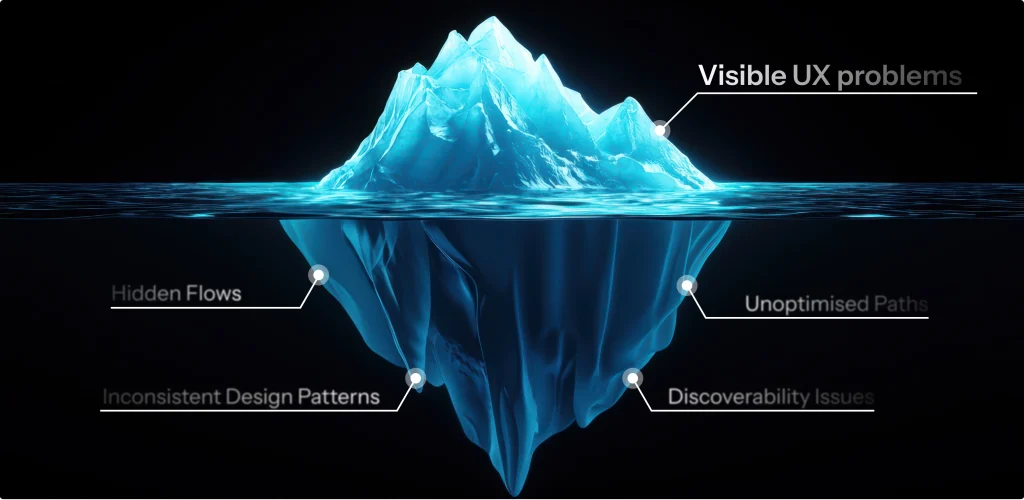
Research shows that unaddressed UX debt leads to increased onboarding times, higher support costs, and, in documented cases, retention drops of up to 20%. A shortcut that saves $200k in proactive refactoring can cost millions in churn the following year.
Markets shift. User needs expand. New segments emerge.
Scalable SaaS product design anticipates this. It builds systems. Modular architecture allows new features to be added without restructuring existing logic. Flexible design systems allow visual evolution without breaking consistency.
The key principles here are:
Flexibility also means thinking about user roles and access logic before they become urgent. Many SaaS products hit a growth wall when enterprise clients arrive, and the product has no permission structure to support them. Building role-based access, multi-tenancy, and configurable workflows into the design logic early is anticipating the next stage. The cost of adding these structures at the MVP stage is low. The cost of retrofitting them at scale is high, in both development time and UX disruption.
This is also where the monolith-versus-microservices question becomes practical. Many teams start with a monolith-first approach using a containerized stack. This is the right call for the MVP stage. The transition to microservices happens later - when specific scaling bottlenecks are identified. Designing for that transition from day one is what makes it manageable.
Product maturity requires a design system that was built to evolve. When UX is structured correctly from the MVP stage, updates are additive. You expand what exists. Navigation patterns become more sophisticated. Dashboards gain new modules. User flows support new roles and permissions.
This kind of evolution is only possible with disciplined iteration from the start. Each design decision should be documented. Each component should serve a clear function. Each pattern should be reusable.
The result is a product that feels consistent at every stage of growth. Users just notice that the product keeps getting better.
A well-structured design system also reduces onboarding time for new team members. Designers and developers can work within established rules rather than reverse-engineering undocumented decisions. This has a direct impact on velocity as the team scales.
For teams building at this level, investing in product design for SaaS products pays dividends at every stage of the roadmap.
Theory matters. But results matter more.
The challenge: SaaS teams often rely on generic design component libraries. These libraries are built for general use. They are not built for specific technical stacks. The result is a constant translation problem between design and development. Designers produce layouts that developers cannot implement directly. Every handoff requires interpretation. Every sprint loses time to misalignment.
The structural solution: On the Activate OS project, UITOP operated as a unified team of designers and developers. Instead of using standard component systems, our team built a proprietary design library. It was built to mirror the actual capabilities of the development environment.

Every design element is mapped directly to functional code. Every layout was ready for implementation without translation. The feedback loop between design and development ran in real time. Visual decisions were validated against technical constraints before they became problems.
The effect on timelines and scale:
| Metric | Result |
|---|---|
| Delivery speed | 66% faster than the industry standard |
| Development lifecycle | 1 month per feature set |
| Team communication efficiency | +40% |
| Technical debt during UI implementation | −25% |
What previously took other development teams three months, we delivered in one. This is what strategic design alignment looks like in practice. And it is replicable when the design system is built to match the technical stack from day one.
Design and architecture are the same decision, viewed from two angles. When design evolves without architecture, the product becomes visually inconsistent. When architecture evolves without design, the interface breaks. Both must move in sync.
This means designers need to understand component boundaries. Developers need to understand UX logic. Product decisions need to account for both.
This mindset is core to scalable MVP development - decisions made at the MVP stage define how far the architecture can stretch later. The teams that build scalable products treat this as a non-negotiable. Architecture informs what is designable. Design informs what is buildable. Long-term scalability is the outcome of that alignment.
The broader lesson applies beyond any single project. When design and development operate as separate tracks, with handoffs, translations, and interpretation gaps between them, every sprint absorbs unnecessary friction. Design decisions get made without technical input. Technical decisions get made without UX input. The product ends up reflecting the gap between the two disciplines, not the intent of either. Closing that gap through shared component libraries, aligned workflows, and real-time feedback loops is one of the highest-leverage investments a product team can make.
In practice, this means running design reviews alongside scalable web application architecture reviews. It means including designers in technical planning sessions. It means that when the data layer changes, the UX layer is updated in the same sprint.
SaaS product growth is a product outcome. Acquisition brings users to the door. Product design determines whether they stay. Retention, expansion, and referral all depend on the quality of the experience. A product that breaks under load loses users. A product with inconsistent UX loses trust. A product with poor information architecture loses engagement.

Sustainable growth requires product-level thinking at every stage. This means treating design as infrastructure, making architecture decisions with the long-term in mind, and building for the users you will have, not only the users you have now.
Research supports this directly. Teams that actively manage and reduce technical debt achieve significantly faster service delivery times. Products with clean, consistent UX see measurably better retention and lower support costs. The compounding effect of good early decisions is as real as the compounding cost of bad ones.
This is how SaaS companies scale without constantly rebuilding and how product teams stay ahead of their growth curve instead of chasing it.
Need to develop an MVP?
Looking for a long-term design and development partner who understands SaaS from strategy to launch?
Contact usThe foundation you lay at MVP determines how far you can go. Scale is a day-one discipline.
Every design decision is an investment. Make them with scale in mind. Align architecture and UX from the start. Manage debt before it accumulates. Treat your product as a long-term system, not a short-term deliverable.
Ready to build a product designed to scale? UITOP brings strategic design thinking to every stage of SaaS development.
A scalable MVP uses modular components and clean architecture from the start. It avoids hardcoded logic. It is built to extend.
Define design systems and component libraries before development begins. Document decisions. Align design and architecture at every sprint.
A full redesign is rarely necessary if the foundation is solid. Redesign becomes necessary when the structure cannot support new functionality without breaking existing UX.
It means building a lean product that is structured to grow. It prioritizes architectural decisions that support future features without overengineering the first version.

