 How we use AI in our process

Design, Product, Development
/
Apr 02, 2026

When horizontal SaaS is built to work for many industries at once (which means it's optimized for none of them specifically), that’s when vertical software development enters the conversation.
Vertical software is architected around the actual processes of one industry - the compliance logic of aviation maintenance, the care coordination workflows of healthcare, the operational cadence of logistics. The decision to build industry-specific software is about whether the system can actually model how the business works.
In this article, we discuss what vertical software development implies and how to approach it correctly.


Learn how it works
Looking for a development partner who already speaks your industry’s language and understands your operational challenges?
Contact usTo understand the vertical development meaning, it helps to start with what it is not. Many SaaS tools are built horizontally. Horizontal SaaS is designed to be industry-agnostic, working reasonably well for any business type. Intuit's QuickBooks, for example, handles accounting for a law firm, a restaurant, and a construction company using the same underlying logic.
Vertical software development takes the opposite approach. Instead of building a general-purpose tool, it creates systems architected specifically around the domain processes, regulatory requirements, and user roles of one industry. A compelling contrast: while QuickBooks works for anyone, M3 is an accounting platform built exclusively for the hotel industry, with revenue management tied directly to room occupancy and property-level cost centers that no generic tool natively supports.
Vertical development is not simply "custom software." Custom means building for one company's preferences. Vertical means embedding domain expertise, operational workflows, and industry-specific architecture into the product's foundation, serving an entire market segment.
The difference becomes clearer in a side-by-side comparison:
| Dimension | Horizontal SaaS | Vertical Software |
|---|---|---|
| Target market | Any industry | One specific industry or niche |
| Feature depth | Broad but shallow | Narrow but deeply specialized |
| Customization | Limited, via settings/plugins | Built into the core product logic |
| Domain expertise | Generalist | Industry-specific by design |
| Example (Accounting) | QuickBooks (Intuit) | M3 (hotel accounting software) |
| Integration model | Standard APIs | Native integrations with industry tools |
| Scalability | Generic growth path | Grows with industry-specific workflows |
Is your industry missing?
Let us know your field of work, and we’ll share a relevant case study in PDF format.
Contact usThe signs rarely appear overnight. At first, teams find workarounds. A custom spreadsheet here, a manual export there. But over time, these patches compound into a systemic problem that actively slows the business down.
Four recurring patterns signal when a company has outgrown horizontal SaaS:
Together, they signal that the software has stopped serving the business and started constraining it.
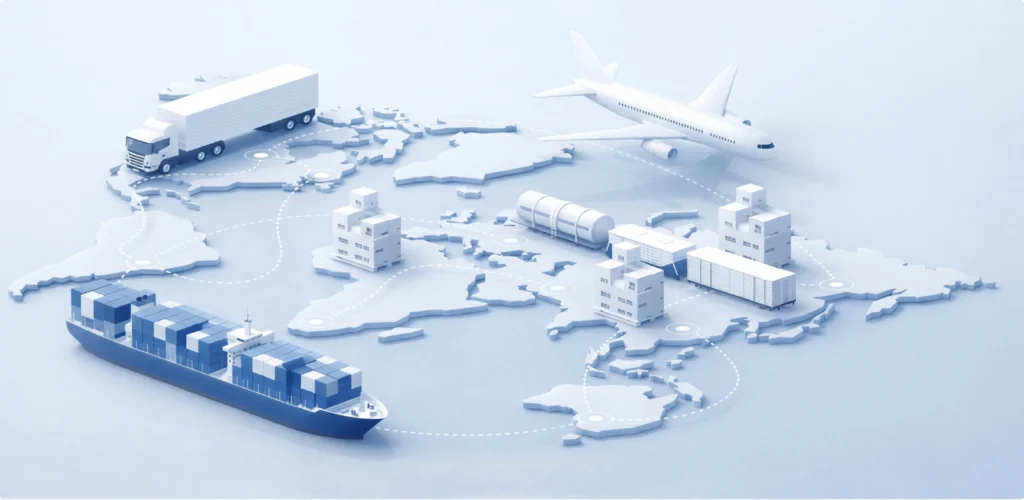
The limitations of horizontal SaaS surface differently depending on the vertical. Across CRM, ERP, supply chain, and logistics, the failure patterns follow predictable industry logic.
A useful illustration: consider Toast POS, purpose-built for restaurants. When a guest places an order, it flows to the kitchen, gets routed to the right preparation station - grill, salads, bar - synchronized for simultaneous service, and then processed through a split-bill payment. Without a deep understanding of this precise sequence, a generic point-of-sale system produces nothing more than a cash register.

Vertical software development is primarily an architecture challenge. Getting the domain logic right is necessary but not sufficient - the system also needs to be built in a way that can evolve as the business scales, as regulatory requirements change, and as new integrations become necessary.
In web application architecture for complex systems, the decisions made early in the design process determine whether the system can grow gracefully or accumulate technical debt with every update.
Three architectural principles consistently separate well-built vertical software from systems that become liabilities:
One of the most common triggers for vertical software development is the realization that the existing tool stack cannot be meaningfully integrated. ERP, CRM, and warehouse management systems accumulate in organizations over the years, often from different vendors, with different data models, and no shared understanding of what a "product," a "customer," or an "order" actually means.
The result: data quality degrades at every handoff, reporting requires manual consolidation across exports, and reconciliation becomes a recurring burden.
Custom vertical software solves this at the product level. When the system is designed around the actual operational model of the industry, integration is built into the core product design for complex enterprise systems. The data model reflects how the business actually works, not how a generic platform vendor assumes most businesses work.
Customization follows the same logic. Generic platforms have a configuration ceiling. Logic that falls outside it is either impossible to implement or requires engineering effort that exceeds the cost of purpose-built software.
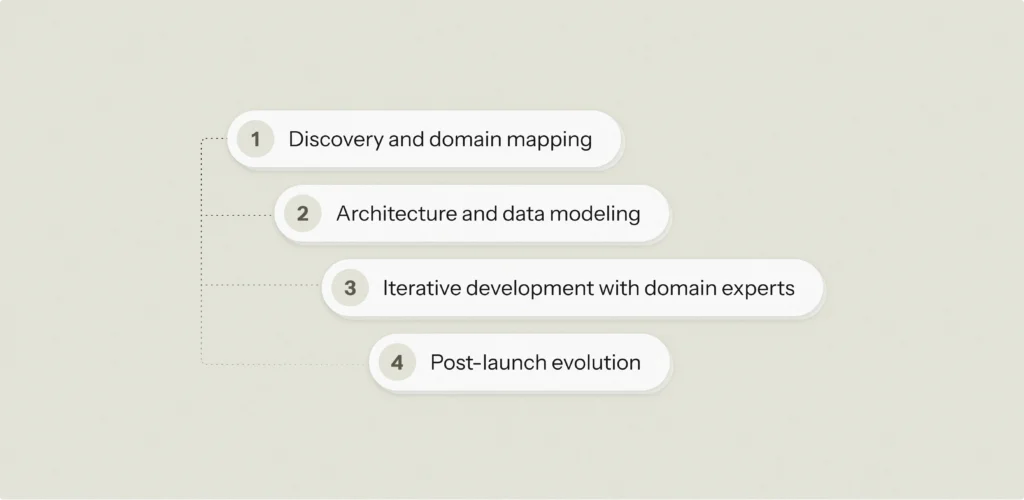
Each vertical development stage requires a product-first approach that invests significantly in understanding the domain before writing a line of code. Skipping or compressing any stage in the vertical development stage sequence is one of the most common reasons vertical software projects underdeliver.
Each stage builds on the previous one. Compressing or skipping any of them typically surfaces as a product that works in demos but fails under real operational load.
As a dedicated software development company, UITOP has worked across multiple verticals where the limits of horizontal software have created concrete operational problems. Three cases illustrate what vertical software development looks like in practice.

Problem: Aviation maintenance companies were working with manual, paper-based workflows for tracking compliance deadlines, maintenance schedules, and fleet status. Existing generic tools could not represent the compliance hierarchy of aviation regulations or the real-time coordination required across mechanics, aircraft, and maintenance stations.
Architectural solution: We designed WingWork from scratch as a cloud-based B2B SaaS platform built specifically for private aviation. The system introduced a dual-dashboard architecture separating real-time aircraft status from detailed maintenance scheduling, automated task tracking tied to compliance deadlines, and an inventory module with real-time visibility into parts and stock.
Business outcome: The platform launched in four months, achieved a 97 usability score, and generated 120% growth in new users in Q1. WingWork has since been recognized by aviation associations as the easiest-to-use software in the industry, a result that is only achievable when the software reflects the actual mental model of the people who use it every day.
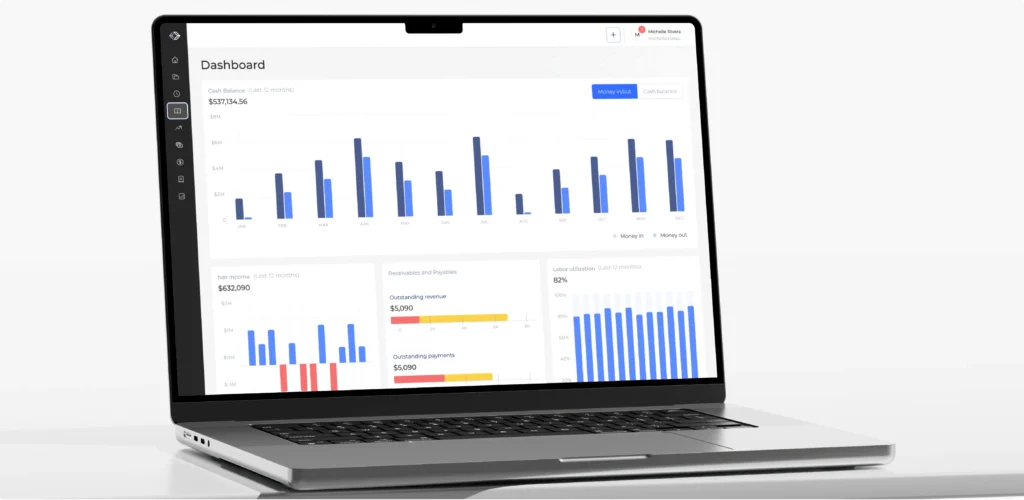
Problem: Fitness and wellness businesses were managing member data, class scheduling, payments, and analytics across fragmented screens and disconnected workflows. Admins needed an excessive number of clicks to perform basic tasks. The resulting friction made it difficult to sell the product to B2B clients who expected operational efficiency.
Architectural solution: UITOP redesigned AirClub's B2B SaaS platform to consolidate all member-critical information onto a single, role-appropriate screen. A unified member management view, a centralized weekly scheduling interface, and a lead funnel for tracking conversion replaced the scattered multi-screen navigation.
Business outcome: The redesign reduced churn rate by 87%, achieved an ease-of-use score of 96, and the accelerated development process, enabled by a unified component library, cut design-to-development time significantly. AirClub was subsequently acquired by a major New York gym chain, a direct result of the product's demonstrated operational value.
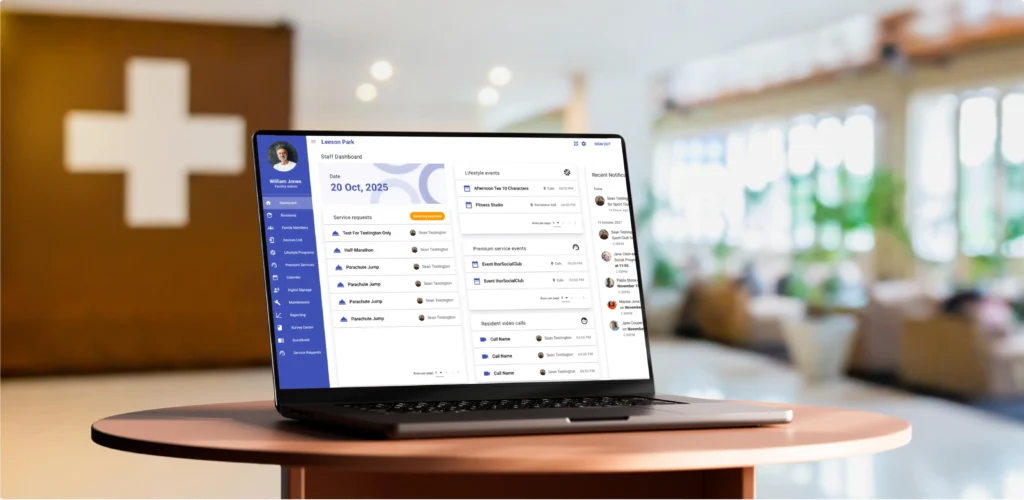
Problem: Medical staff coordinating care for elderly patients were juggling scheduling, documentation, and family communication across disconnected systems with no unified view. The lack of a central platform created delays in identifying urgent patient needs and made daily planning error-prone.
Architectural solution: UITOP built ResHub as a multi-module platform with a scalable, modular design system at its core. The dashboard was restructured to surface urgent patient updates immediately. Calendar views were redesigned around care-planning logic. Feedback survey workflows were simplified for the cognitive constraints of both staff and senior patients.
Business outcome: The platform's healthcare-specific design enabled seamless integration into daily clinical workflows. ResHub was subsequently acquired by Person Centred Software and expanded to the Australian market.
The decision to invest in vertical software development is both a technology and a business strategy decision. The question is whether the operational advantage it creates justifies the investment.
Custom vertical development makes strategic sense in three situations:
In these situations, vertical solutions are the only option that addresses the root cause rather than the symptoms.
The true cost of horizontal SaaS includes manual reconciliation, failed integrations, compliance risk, and the opportunity cost of capabilities the platform simply won't support - costs that compound quietly over time.
Vertical software as a strategic investment means owning the operational logic that defines the business: a system that scales on the right dimensions, integrates with the tools the industry actually uses, and evolves with regulatory requirements.
Explore service
Vertical software requires deep understanding of industry-specific workflows.
Contact usOff-the-shelf SaaS is a rational starting point. It reduces time-to-operation, lowers upfront cost, and covers the basics competently. But for businesses operating in industries with complex workflows, regulated environments, or deeply specialized operational logic, horizontal platforms eventually become constraints rather than enablers.
Vertical software development is a systematic approach to building systems that reflect how a specific industry actually works, with the right data models, integration patterns, compliance structures, and user workflows. The difference between software that merely supports operations and software that defines competitive capability often comes down to whether the architecture was built for the industry or adapted to fit it.
The companies that treat vertical software as a strategic asset are the ones that build operational advantages that generic tools simply cannot replicate. They control their data, own their workflows, and achieve scalability on their terms, growing along the dimensions that actually matter for their industry.
Rethink whether your SaaS stack supports your real business processes. If it does not, our team at UITOP is here to become your vertical software development partner. Contact us today to discuss your project specifics!
Software built for a specific industry – domain logic, architecture, and workflows are designed as one unified system for a defined market segment.
Custom SaaS is built for one company’s preferences. Vertical development targets an entire industry segment, embedding domain expertise into the architecture so the system serves the operational reality of a sector.
When teams spend more time working around the software than with it. When integrations require constant manual reconciliation, when the platform’s customization ceiling blocks critical business logic, and when compliance requirements can’t be met reliably. Any one of these is worth investigating; all four together make a clear case.
Upfront investment is higher, but the right comparison is total cost of ownership, not subscription vs. development cost. Horizontal SaaS carries hidden costs: workarounds, manual reconciliation, failed integrations, and capabilities you simply cannot build. Vertical software eliminates these and scales efficiently along the dimensions that actually matter.
Aviation and aerospace, healthcare, logistics and supply chain, construction, and regulated financial services. Any industry with non-standard workflows, strict compliance requirements, or highly specialized data structures that generic platforms cannot model accurately.

