Product, Startup • Aug 13, 2025
 How we use AI in our process Learn more
Business-to-business software as a service (B2B SaaS) is a technological wonder that has shaped the digital product industry. This is not surprising, as such solutions are created and maintained by developers. At the same time, business owners receive the best-performing version and leverage its potential from day one, without incurring huge upfront costs.
A SaaS platform is a cloud-based program that users access by paying subscription fees. It doesn't require any downloading or installation. Just having the credentials to a paid account already lets you in. This model is affordable for businesses and profitable for providers.
The difference between B2B SaaS products and B2C ones is in the end user. In the first case, the solution is sold to companies and enterprises for enhancing their internal communication, analytics, automation, and other processes. The second model sells cloud-hosted applications to individual users. For instance, you watching Netflix equals you using a B2C SaaS platform. However, when working at the firm and using Slack, you are utilizing business to business software as a service.
In this article, we will discuss how to prepare a strategy and execute it successfully to build an enterprise-focused SaaS program.
The product hosted on the cloud and distributed across companies refers to a B2B SaaS platform. These applications differ from traditional software mainly in how they are accessed, their business model, and their ability to scale. The core of B2B SaaS solutions is delivering the product on subscription-based pricing, with remote access, superior scalability, and continuous updates that don't disrupt workflows.
Popular B2B SaaS examples are Salesforce for managing interactions with customers, Slack for team communication, and Notion for Teams for collaborative documentation.
Those products are also divided by type:
Every solution delivers rich functionality through cloud access and allows businesses to grow as they go, together with software.
B2B and B2C are primarily distinguished by who they serve and how they operate. B2B offers are tailored for teams, organizations, and specialists. Thus, they have a specific UI/UX design aimed at optimizing workflows and increasing productivity, rather than simply presenting an interactive and minimalist interface. Sales cycles are usually longer, and final decisions depend on many people. Onboarding is more complex and requires specific training and support.
The B2B SaaS business model is beneficial due to the following aspects:

However, there are some challenges you might face. The sales cycles will take longer, and you will have to adapt to what the business needs to show your platform's value. Also, you will need to build a robust architecture for seamless integration with third-party services.
B2B SaaS applications should be created following a strategy that minimizes risks and maximizes market fit. So, kick off the process with the steps.
Look at the market: what pain points users face, what existing solutions and market gaps are. Competitor analysis is also a must. As you define the industry you want to work with, discover how other companies cope and where they fall short. Another critical point of view is what the real user thinks. In the B2B sector, you typically deal with multiple user personas. Mapping out their roles helps build the product functionality and messaging.
Having an idea shouldn't let you go straight to development. Don't write a single line of code until the concept is validated. Adopt a minimum viable product mindset (MVP): confirm the idea will work before scaling. Create prototypes, landing pages, and surveys to gather feedback. Conduct interviews with business clients to determine whether your solutions are effective. This will save you from investing in a product no one needs.
Even though the SaaS product is sold on a subscription-based business model, you can still choose different monetization strategies:
The pricing policy should be considered based on such factors: per seat, depending on the usage, or depending on the feature suite.
At this stage, you will be shaping your platform's usability and scalability. It is crucial to align user needs with business goals through UI/UX design, architecture planning, and MVP execution.
Architecture is the core of B2B SaaS platforms. The scalability and third-party integrations will heavily depend on it. A great product's architecture has multi-user environments, role-based access, and seamless connection with other services. Build the whole system following the modular approach for easier deployment.
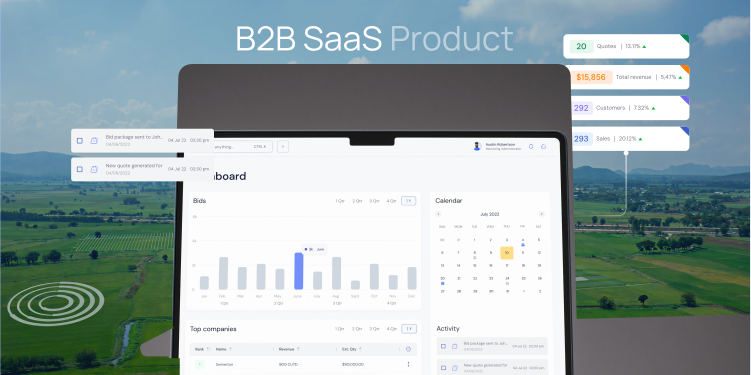
For B2B software, functionality goes first; then the aesthetics follow. Let's take our client's case study, Valocore, a data platform for government contract management. Its dashboard was crafted to give users quick access to KPIs, easy navigation between projects, and customizable views. The result allowed businesses to convert all their paperwork into a digital format thanks to clear interfaces.

In another example of one of our clients, WingWork, an aviation maintenance B2B company, has turned to us with poor usability metrics and functionality that felt like a B2C model and didn't fully take into account business logic. We studied real user needs, restructured information flows, and implemented a component-based UI system.

Our work resulted in a +47% in user engagement, a reduction of support tickets, and an 88% conversion rate. This confirms the importance of UX thinking with a B2B focus.
So, correctly putting design focus can change a lot. And if the collaboration happens with powerful tools for commenting, assigning, and tracking in a shared environment, the workflows fly "easily as birds".
When choosing a tech stack, opt for solutions that are great in terms of maintainability. For instance, use React or Vue for the frontend, Django or Node.js for the backend, MongoDB or PostgreSQL for building databases, and a CI/CD approach for DevOps practices.
Make sure you follow the industry compliance rules like GDPR or SOC 2 to avoid legal risks and gain user trust.
To validate product-market fit, focus on the core functionality. Conduct manual and automated quality testing. And don't forget about providing users with guidelines as part of the onboarding process.
This is the phase where your product meets users. It also requires proper planning for attracting early adopters and reducing risks before scaling.
Before you present the product at full scale, consider launching its beta version. This will allow you to test the platform in a real-life environment and see where adjustments are needed. Evaluate these metrics: engagement rate, activation rate, return frequency, and support requests.
Combine tactics of outbound and inbound marketing. For the inbound strategy, include blogs, webinars, guides, and case studies to showcase your product value. For the outbound reach, enable email marketing, LinkedIn networking, and cold calls.
Content is an essential part of the sales process as it builds credibility. Cooperate with bloggers, be active in social media, and this is how you will be noticed.
Even at the MVP stage, you still need customer support. On top of real agents who should help users, also create a knowledge base to cover core questions. Establishing customer success workflows will help you track the onboarding process and adoption rates.
The work is not done once you reach the market. It is a continuous process, and to scale, you need to track key success metrics such as customer acquisition cost (CAC), lifetime value (LTV), monthly recurring revenue (MRR), and churn rate.
As you receive user feedback, you should iterate on the platform, considering what clients think. Those meaningful insights identify what brings real value and what causes confusion. And if you do everything right, you will grow, so you will need to hire more professionals, expand sales teams, and invest in better cloud architecture solutions.
To execute all those steps, additional funding options are needed. As a startup, you can choose to bootstrap and have complete control over the processes. Or, you can always venture capital or angel investment to capture the market faster.
To save your time and resources, don't fall into the trap of those mistakes:
B2B SaaS companies produce platforms for many industries, solving unique user challenges. Below are the examples that illustrate the range and impact of these solutions.

Relounge web platform, designed by Uitop, is a CRM solution for fitness and wellness businesses. It helps coaches and fitness studios track their leads, communicate with clients, and see their progress. All those features are managed from a single interface because the UI/UX design was executed with efficiency and usability in mind.
Asana is a widely known project management tool that helps teams set up tasks, projects, and goals in an easy way. The workflows are fully customizable with automation features included. This is why tech startups and enterprises use it for organizing work.

Workday is a perfect example of an HRTech SaaS platform that supports specialists with multiple processes: hiring, payroll, and talent management. Its role-based access feature allows employees to enter different spaces based on their position and tackle complex organizational challenges.

Developing and launching a B2B SaaS product requires a proper strategic approach: from identifying a niche problem to iterating software based on user feedback. A well-thought-out UI/UX design is pivotal as it shapes intuitive user journeys and aligns product experience with business goals. Focus on value, usability, and continuous improvement to scale confidently.
And if you want to accelerate your go-to-market success, reach out to a product design agency that specializes in building B2B SaaS platform designs.