
Product • Dec 08, 2022
 How we use AI in our process Learn more
Imagine building a fitness application, spending months polishing every line of code, and developing advanced features like a custom macronutrient breakdown calculator. Then, after the product launch, you realize that users didn't engage with that functionality and found your SaaS solution unhelpful. You failed not because of bad code, but because you didn't put customers first and focus on design.
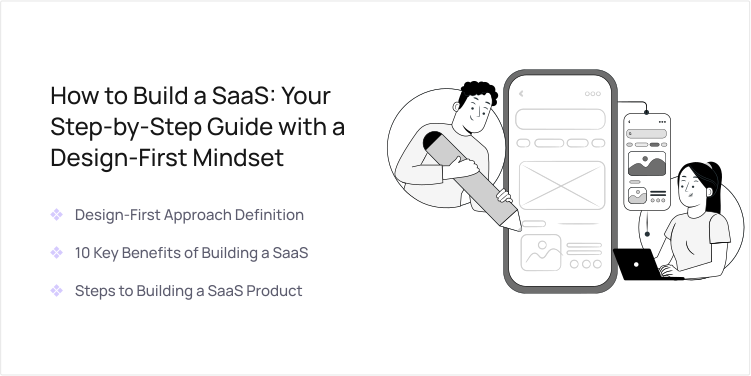
When creating a SaaS product, it is crucial to follow a design-first approach. It's a mindset where developers dig deep into user experience, customer needs, and desired features before writing any code. This concept prioritizes resolving customers' problems so that the solutions serve as a base for development tasks.
Here, we will take a comprehensive look at how to build a SaaS product using the design-first approach. We will explore its key principles, benefits, implementation methods, tools, common mistakes to avoid, and many other aspects.
A design-first software development approach refers to prioritizing user experience and interface design from the earliest stages of creating a SaaS platform. Traditional digital product invention instructs specialists to code first. In the design-first methodology, developers and designers first research user personas and their needs, then create solutions and craft interactive prototypes. Engineers start to code only after end-users validate the design version.

Building a SaaS product with a UX-first strategy offers multiple advantages:
The effectiveness of prioritizing design is no longer a question that needs to be proven. Some companies have already conquered the market, and you can learn from their examples.
A well-known project management tool, Notion, didn't introduce America to people. It simply created an easy-to-use instrument that simplifies complex workflows and provides smooth drag-and-drop functionality.
The same fame is pursuing Slack. This tool has become an integral part of everyday internal company communication. Its intuitive interface allows users to forget about emails and switch to an easier way of connecting with colleagues and partners.
SaaS software is not just another cloud-based solution that dominates the market. It is also a proven business model that can be your stable income as long as you put user needs first. You will get these benefits if you decide to create a SaaS application.
SaaS services operate on a subscription-based model. It's a winning solution for both parties: you and your customers. Users receive a tailor-made solution without having to maintain it, and your company gets a stable cash flow.
Building a business on this model, whether on monthly, quarterly, or yearly plans, brings more control over strategy planning and budget forecasting. This financial certainty lures investors. So, your SaaS idea can outperform a traditional digital product idea only with this factor.
Business needs, client base, and data volume grow as companies evolve. However, this doesn't pose a challenge for a SaaS solution. Thanks to its cloud-based nature, the product can serve millions of people without interruptions.
This is beneficial for both your customers and you. Users receive a highly flexible platform that "grows with them". And you don't need to invest significant costs and resources into development once new scales appear. If you build a SaaS on the proper infrastructure, the app can withstand spikes in demand.
The cloud in this technology has the exact nature as the one you see in the sky: floating like silk in the breeze. In the digital world, it means that your product is available 24/7 from anywhere to anyone, for any purpose. Users are not required to have specific devices or browsers. They only need a stable Internet connection.
This makes your software accessible to people in different countries and time zones. SaaS solutions are perfect for remote teams that work from around the globe. The technologies enable instant synchronization and connection.
Traditional platforms are physically distributed or require users to install them. With a SaaS product, this is not the case as it is digitally enabled for every user. The only thing customers have to do is log in.
Since you, as a developer, are responsible for maintaining the app, you can implement changes and bug fixes in real-time. This centralized model of control makes it ideal for governing cloud-based technologies while users are using them.
If you discover the issue on the platform, there is no need to put it on hold and show customers the 404 error. The SaaS model allows for fixing bugs, adding new features, and strengthening security in real-time. Users also don't need to update the app version, as improvements are reflected instantly.
This sets perfect conditions for agile development, which improves over time and as customers' needs evolve. You can test new features, gather feedback, and update the app without disruption.
To learn more about end-user expectations after the product launch, you don't need to conduct countless tests and analyze the results. You can simply enable real-time analytics on your SaaS product and see which features are used often and which areas need improvement.
Actionable analytics allow developers to follow a continuous optimization path. By seeing real user scenarios, you can better tune the app for the target audience's needs.
Subscription-based business models are a prevailing benefit. But you might be wondering: "How do I keep users enjoying the app so that they stay longer and pay more?" This is also not a challenge for cloud-based platforms. If you invest in seamless design, customer support, and onboarding, you are already on the winning side. Personalization and focus on solving specific user needs make them stick with your product.
Building a secure platform means investing in compliance with laws, maintaining a good brand reputation, and avoiding unfortunate situations. With SaaS technologies, being in control of user data and sensitive information is easier as the access is centralized.
If you invest in healthcare or finance SaaS software development, you need to comply with HIPAA, ISO, and GDPR for all industries. Cloud-based services are easier to manage and support, which builds trust and confidence between you and your customers.
One of the functions that distinguishes an advanced product from others is the ability to integrate with third-party services. Businesses want to have everything in one place, which is very convenient. SaaS platforms enable developers to integrate with CRMs, analytics platforms, marketing tools, and payment gateways.
Cloud-based technology works as an ecosystem, seamlessly allowing other apps to serve user needs.
Due to high scalability, yesterday's no-name product might be tomorrow's Zoom or Figma. This encourages developers to invest in SaaS platforms.
When putting a lot at stake, like when buying real estate, you expect to receive value or be able to resell the object for a reasonable price. With thoroughly crafted SaaS software, you can make a great deal and attract investors easily, as the business model generates revenue from the first day after purchase.
If you're wondering how to create SaaS products, this comprehensive guide will walk you through the main steps.


The core value of any digital product is to deliver specific solutions to users. Without researching honest user feedback, you will be playing a guessing game. To learn more about the audience, you can interview users, create questionnaires with Google Forms or Typeform, and analyze their logic via UserTesting.com or Hotjar.
To see successful examples, research your competitors. Dig into user reviews and learn what users like and don't like for your project.
To define your target customers, build user personas. Include their demographics, behavior, needs, pain points, and expectations. Use empathy mapping to dig deeper and learn about their feelings, thoughts, and words.
When customers open the product, they have a mission, and they go in specific directions. Your task is to track what roads they choose, where they stop, and how they think.
The main stages of the journey are: awareness > consideration > onboarding > engagement > retention.
As you know what the users want, you can start by drawing simple low-fidelity wireframes. Then, after approving design ideas, you can move to high-fidelity layouts with the help of Balsamiq, Sketch, and Figma tools.
Prototyping helps visualize ideas, quickly iterate on concepts, and save resources for future redesign.
A successful design is visually appealing and functional. It has to be clear, minimalistic, structured, accessible, and responsive. When building interfaces, add microinteractions. Feedback and updates support users throughout their journeys.
Before reaching the market, ensure you have developed the right product. Let users evaluate it. Conduct A/B testing on various workflows and observe which concepts work best. Use metrics to measure effectiveness, such as task completion time, error rates, net promoter score (NPS), and drop-off points.
Usability testing will offer valuable insights into your developments.
Your prototypes may be excellent, but if you don't effectively communicate with developers and provide comprehensive documentation, progress may be lost. When handing off the project, ensure your Figma files are well-structured. Utilize Tailwind CSS and Storybook tools to maintain consistency in your designs.
Identify the core functionality and create a minimum viable product (MVP). With a basic version of the app, you can test it on real users and gain valuable information on how to complete the whole picture. To deliver quickly and iterate easily, rely on Agile and Lean methodologies.
Embed analytics into your MVP with Amplitude or Mixpanel tools and receive real data for your product.
SaaS product launch is the beginning, not the finish. Once your app reaches the market, you should collect feedback, gather data, and turn it into insights for further improvements. Analyze churn reasons, functionality usage, and onboarding drop-offs to spot the friction points.
Even if you put design first and have a professional team on board, you can still face challenges and constraints. To protect your company from failures, be mindful of not repeating these mistakes:

As a leading SaaS UI/UX design agency, we understand the importance of having a practical toolkit. Our designers use the following instruments at different stages of designing SaaS products:
The cost to build a SaaS product depends on many factors: product complexity, size, level of scalability, tech stack, functionality, design requirements, and third-party integrations. Following a design-first approach in SaaS creation is more expensive, but it reduces many risks.
This is a breakdown of costs depending on the product size:
If you choose to follow a design-first approach in SaaS development, you need a team with more than just solid technical skills. You need someone proficient in conducting in-depth user research, understanding customer psychology, and turning user data into UX solutions.
Partnering with a professional design agency like ours can be a winning decision, as you'll reach the market quicker with a superior product.
A design-first approach is a set of effective practices and principles that shape a successful SaaS product. By investing resources into UX from the very beginning, your company validates ideas before coding, saving time and money on redesigning.
Choose user needs and design solutions as your priorities, and your application will stand out on the market!
In this way, you will validate your ideas and test them on real users. This is much easier when you code first and then implement changes to the written code.
The timeline depends on the scale of the product. For an MVP, designers and developers spend around three months. Fully featured SaaS platforms can take up to a year.
If you have a professional design team, you can execute the processes on your own. But a design agency can provide you with expertise that not all in-house professionals have. This is because such agencies focus strongly on design and already know all the pitfalls.
Definitely, products that are built with UI/UX design as a priority have higher conversion rates, activation rates, adoption rates, and lower churn rates. Design-first approach means more than just aesthetics. It’s about building products that users will use and love.