 How we use AI in our process


Creating Fintech Products
Users Can Trust
Make complex financial actions easy to understand
Users should be able to review money-related actions without extra effort. Good fintech UX design puts the amount, fees, recipient, timing, and result in a logical order, while product logic supports each step from input to confirmation.

Build trust into every critical user flow
Sensitive actions need a reliable path from start to finish. UX design for fintech products connects onboarding, account access, approvals, payments, statuses, and backend logic so users understand what is happening at each step.
Balance usability, security, and product growth
Security checks work best when they are part of the flow. Verification, permissions, limits, and alerts need to be planned in the interface and supported in the backend to protect users while keeping core actions efficient.
Selected Metrics That
Reflect Our Product Delivery Experience
Our Clients About UITOP’s
Fintech Products Work


Cole Weiler
CEO, BoltWise“They took way more responsibility than we asked and we were so happy with the results of all their work. UITOP was easy to work with, flexible, and valuable to our company.”


Neil Hosey
ResHub, CTO


Dylan Gambardella
Founder, Different Health“They took extra time to ensure that our frontend developer could easily implement the wireframes.”

Sam Jordan
TrovBase, CEO

Dirk Pauw
CEO, Tavas“We’re most impressed with UITOP’s ability to come up with a system to be able to bring design solutions.”

Jordan Girard
Whiterock, Founder

Jake Heimark
Costa Security, CEOu0022We are happy with the improved UI/UX, which has made product navigation cleaner, simpler, and more intuitive. The team is great and always there to help.u0022

Michael Mosseri
Total Brokerage, CEO

Nicolas Endress
ClimEase, CEO
Fintech Product Challenges
We Help Solve
Fintech Product Design and Development Cases

Automating financial workflows for government contractors
Valocore needed to replace paperwork-heavy financial workflows for US government contractors with a platform for invoices, payments, reports, and deadlines. We designed and developed 6 modules for invoicing, billing, secure payment tracking, reporting, income statements, and balance sheets.
As a result, the platform brought the full financial lifecycle into one place. Contractors can export audit-ready reports in one click, speed up invoice approvals and payment cycles by 2x, and reduce the risk of expired deals or missed deadlines.

Growing an accounting platform into a SaaS product
Pacioli was created for MedTax, a Canadian accounting firm working with healthcare clients. The team required one system for client records, transactions, and tax work.
UITOP handled fintech app design and development from scratch. We built the product logic, accounting workflows, QuickBooks integration, and automation for recurring finance tasks. Over time, Pacioli moved beyond internal use and became a SaaS platform for accounting operations, client management, transaction tracking, and tax processes.

Making global money transfers easier to start, track, and manage
Sending money across borders involves rates, documents, recipients, confirmations, and status updates. For TangoPay, the challenge was to keep these steps understandable while the platform connected different financial systems behind the scenes.
Our fintech design services covered 350+ screens for the customer app and back office, including the rate calculator, document scanning, transaction history, money transfer flow, dashboards, reports, and account management. The product launched in 4 months and reached a 96 ease-of-use score, 97% design-to-code success, and 92% user retention.

Why Companies Choose UITOP
for Fintech Product Development


Our Fintech
Design and Development Services
Fintech Product Discovery and Strategy
Product goals, users, and financial workflows
UITOP starts with the business model, user roles, money-related actions, and operational limits. This stage defines what the product will calculate, store, approve, display, and automate before screens or technical tasks move into planning.
Feature scope and delivery priorities
A focused release plan keeps fintech products from becoming overloaded too early. We define core functionality, required flows, dependencies, and delivery stages, so the first version covers essential scenarios without carrying every secondary idea into launch.
Technical requirements and integration planning
APIs, external systems, sensitive data, access rules, and security-related constraints can affect the whole project. Our team reviews these parts early and plans integration points, data exchange, architecture decisions, and release risks before development starts.


Fintech UX/UI and Product Design
User flows for onboarding, payments, and daily actions
Registration, account setup, transfers, payments, dashboards, and support requests all involve different levels of risk and user attention. UITOP designs these journeys around real tasks, required checks, transaction details, confirmations, and recovery options.
Clear interfaces for complex financial data
Financial products often include tables, charts, reports, histories, balances, and changing statuses. Our design agency financial services focus on layouts that help users compare values, check updates, find records, and continue work.
Responsive web and mobile product experiences
Fintech users may review data on desktop, approve actions on mobile, or switch between devices during the same workflow. Our fintech design agency adapts navigation, layouts, forms, and data views for different screen sizes while preserving the main product logic.


Fintech Software and App Development
Front-end and back-end product development
Our fintech app development company builds both the user-facing part and the system logic behind it: dashboards, roles, permissions, databases, modules, transaction flows, and admin tools. Interface behavior is planned together with the rules that process actions and data.
APIs and third-party integrations
Fintech platforms may rely on payment services, banking infrastructure, identity providers, analytics tools, accounting systems, or other external products. Our team plans data exchange, fallback scenarios, error handling, and status updates based on the confirmed technical scope.
Testing, performance, and release readiness
Before release, the product is checked across critical flows such as onboarding, payments, account actions, reports, permissions, errors, and edge cases. Our fintech software development company reviews behavior, performance, interface states, and any issues that could affect real users.


Fintech Product Modernization and Growth
UX audit and product redesign
For an existing fintech product, UITOP can review user flows, interface issues, friction points, and product logic gaps. The audit lets us identify what limits conversion or daily use, while during redesign, we focus on improving actual tasks.
Architecture and feature modernization
Older systems can make new modules, integrations, roles, and reports harder to add. Our fintech development services also focus on updating the product structure, revising outdated flows, and improving feature logic so the platform supports new business scenarios with fewer operational limits.
Continuous development after launch
Once the first version is live, the work often continues with new reports, integrations, access roles, and updates to existing flows. UITOP can support ongoing fintech software development based on user feedback, analytics, and business priorities.


Fintech Products We Design and Build
Digital banking and account platforms
We design and develop banking platforms where users can check balances, manage accounts, review operations, and track account statuses. For internal teams, UITOP can build dashboards, user roles, access logic, and tools for working with financial records.


Payments, transfers, and embedded finance
UITOP also works on payment scenarios for transfers, wallets, transaction statuses, fees, limits, confirmations, and embedded financial features inside other products. Each flow is planned around user action, system response, and the information required before a transaction is submitted.
Investment and wealth platforms
Our team can create products for portfolios, assets, analytics, market data, and investment decisions. The interface can support charts, performance views, account history, reports, and data-heavy dashboards without making users search through scattered information.

Lending, mortgage, and credit products
Loan and credit products often involve applications, document checks, calculations, approval stages, repayment schedules, and status updates, which we design and develop for fewer manual steps.

Tax, accounting, and financial management software
UITOP builds software for tax calculations, bookkeeping workflows, financial reporting, reconciliation, and operations management. These products can include client records, transaction handling, accounting integrations, dashboards, and automation for routine finance tasks.

Government finance and procurement platforms
Last but not least, we work with digital products for government contracting, procurement, tenders, financial operations, and reporting. The platforms our team creates can support contract data, approvals, deadlines, payment tracking, audit-ready documents, and collaboration between organizations and contractors.

Our Fintech Product Development Process
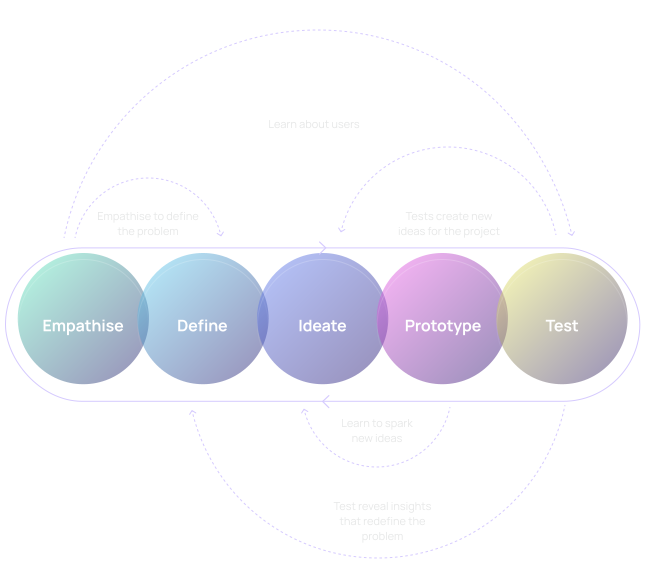
1. Understand the product, users, and financial flows
2. Define the scope and technical direction
3. Design and validate the core experience
4. Build the product and required integrations
5. Test critical flows and prepare for launch
6. Launch, learn, and evolve the product
Technologies and Delivery Practices
for Fintech Products
When providing custom fintech development services and product design assistance, we rely on tools and practices that make product work easier to manage: design collaboration, front-end and back-end engineering, version control, testing, integrations, and project management. Fintech features, data logic, and release tasks stay connected from planning to launch.


Frequently asked questions
What fintech software development services does UITOP provide?
UITOP provides fintech custom software development services for teams that need to plan, design, build, or improve a financial product. The work can start with discovery and product design, continue with web or mobile development, and include front-end, back-end, integrations, testing, and launch. Our team can also join an existing platform. Typical tasks include payment flows, account access, onboarding, dashboards, reports, transaction statuses, and internal financial tools.
Can UITOP design and develop a fintech product from scratch?
Yes. UITOP can take a fintech product from an early idea to a release-ready solution. Our team first defines the product concept, user roles, financial scenarios, data requirements, and technical limits. Then, UX/UI, frontend, backend, integrations, testing, and launch preparation are handled as one connected process. This format works for MVPs, full-scale fintech platforms, and new modules for existing products, including payment flows, dashboards, account access, reporting tools, and admin functionality.
Can you work with an existing fintech app or platform?
Yes. Our fintech design and development agency can join an existing fintech product at the point where support is needed: redesign, modernization, new functionality, integrations, or ongoing development. We may work on onboarding, payments, account flows, dashboards, reporting, admin tools, or third-party services. Before changing the product, UITOP can review current UX, business logic, technical limits, and user feedback. This helps decide what to update first: the interface, product logic, architecture, integrations, or specific flows that affect daily use.
Do you provide fintech UX/UI design and software development as one service?
Yes. In fintech, design and development often affect the same decisions: how a payment is confirmed, when a user sees a status, which data appears on a dashboard, or how an integration responds to an error. We can handle both sides in one service, from UX/UI to frontend, backend, testing, and release. If your team already has part of the process covered, we can also join for a specific stage, such as fintech product design, engineering, integrations, or post-launch updates.
How do you approach security and privacy in fintech products?
Security starts in the product flow: who can access an account, which actions need confirmation, where sensitive data appears, and what happens when something looks risky. UITOP factors these decisions into UX/UI, backend logic, permissions, authentication, and data handling. Our team can support project-specific privacy requirements and security-sensitive scenarios during design and development.
Can you integrate a fintech product with external systems and APIs?
Yes. Integrations are usually planned around the real job the product has to perform: verify identity, send payment data, sync accounting records, pull analytics, or exchange information with an internal system. During discovery, we review the available APIs, required data, error cases, limits, and user-facing statuses. The exact scope depends on API access, documentation, security requirements, and the technical setup on both sides.
How long does fintech app development usually take?
The timeline depends on what you want to build. An MVP with onboarding, main user flows, and one or two integrations can usually fit a shorter release cycle. A larger fintech app with mobile platforms, admin panels, payment logic, reports, permissions, and several external systems takes more planning and development time. We review the scope, product state, platforms, and technical requirements first, then suggest an estimated launch timeline. Contact us to discuss your product and receive an estimate for your particular project.
What happens after the fintech product is launched?
After launch, we can stay involved with the product work that comes next: fixing issues, checking performance, updating flows, and adding features requested by users or internal teams. Our team can analyze feedback to plan the next release, reduce friction in certain scenarios, and help the product support more users, transactions, and business requirements over time.