How we use AI in our process

Design, Product
/
Oct 01, 2025

In recent times, product design has been unfolding at an unprecedented rate. In an era where audience requirements are growing more complex, both seasoned and fast-growing companies have found their own ways to adapt to these changes.
Technologies like AI or AR/VR are redefining the possibilities, while trends in personalization and seamless interaction are setting the new benchmarks in digital product design. This article will examine the key trends and emerging technologies that will interest everyone who wants to stay relevant and effective in the fast-paced digital development market.
From being a purely aesthetic area, product design became a strategic tool that boosts user engagement and company revenue. Previously important visual appeal has been replaced by the growing trends of personalization and accessibility.
Moreover, products are no longer created for single devices, as audiences expect to use the chosen application across the web, mobile, and wearable devices. Such an intensive growth of new technologies in product design has also become a catalyst for rising expectations for inclusivity and sustainability of the products. Understanding the continuous changes in users' preferences is crucial for business owners and companies who are trying to build a product that feels intuitive and effective.

The evolution of digital product design has brought new trends and technologies. They allowed product teams and developers to completely reshape the design landscape while freeing up additional space for new users" experiences. Below, we have gathered some of the most innovative technologies that will be driving modern product design in the following years.
With the help of artificial intelligence, more companies receive a chance to change the perception of design itself.
For example, Salesforce claims its autonomous AI agents are becoming the new user interface. They aim to orchestrate tasks instead of users. What's left for users is just to tell AI what they require. Plus, the implementation of AI agents into product design significantly eliminates the need to use multiple apps for different purposes, like marketing and sales. AI agents can be versatile and handle diverse functions within a single platform. No scattered data and tab switching.
Moreover, AI may also speed up the ideation and improve the designer"s effectiveness by taking over repetitive tasks and unlocking insights.
Immersive technologies have also become a part of the product design trends. A blend of virtual and physical worlds, both AR and VR became perfect tools for improving experiences connected to simulated experiences, remote training, or visualizations of any kind.
Many companies have already begun to implement those solutions effectively. For instance, in the retail sphere, we have the IKEA app, which allows you to place true-to-scale furniture pieces in your accommodation, or Osso VR, a medical VR–based app, aimed at surgical training.

Conversational UI is another latest technology that has become quite popular these days.
Including conversational UI allowed developers to consider tone, accessibility, and effectiveness of their apps, which were not available before. Examples include programs like Google Assistant, Alexa, and even ChatGPT, where interfaces allow users to complete actions with nothing but their voice.
While blockchain and decentralization of applications are other massive trends in digital product design, they are followed by various challenges. For dApps, we can name wallet integrations, transparency of transactions, and overall trust towards that product.
Therefore, when it comes to Web3, designers face a huge challenge of creating a non-confusing, user-friendly design that can be used by non-technical users. Popular blockchain and Web3 tools include Alchemy, a platform for building blockchain apps, and MetaMask, a widely used crypto wallet.
Nowadays, when users have wearables, interfaces beyond regular screens have become a must. That"s why many designers are facing a new challenge of cross-platform and cross-device experiences.
Among the most popular apps is the Samsung SmartThings, an ecosystem for smart houses, and the basic Garmin Connect for actionable wearable insights.
Advancements in generative AI have opened new opportunities for designers in terms of saving resources and producing ideas. With the help of those tools, product designers can now explore multiple design variations, go beyond their imagination, and reduce time spent on manual tasks.
In particular, this trend helps decrease the gap between the concept and execution, making the development more effective. Among the most popular generative design tools are Figma and Canva Magic Design.

The new systems should go beyond a nice interface - what they really need is to create efficiency and accessibility that resonates with end customers. Below, we gathered the latest trends that will help your team create world-class products.
Minimalism remains one of the strong design principles that allows for keeping interfaces simple without sacrificing effectiveness. However, minimalistic doesn"t mean boring, as when combined with immersive storytelling, you can receive a perfect blend of engagement and simplicity.
Recently, our team has been working on improving the customer support CRM system called Aimiable. During the refinement process, our designers managed to give the product a second wind, after which it became a plain yet effective solution that anyone can understand.

Small, purposeful animations are something that add soul to your application. Little transitions or haptic responses add a great sense of responsiveness, and let your users engage even more. That"s what we have done at Impruvon Health - a mobile app that allows users to control their medication and keep a finger on the pulse regarding their well-being. We managed to turn Impruvon into a simple yet effective app that allows users to follow their doctor's recommendations via engaging interactions.

Accessibility is no longer just an addition, but a necessity, allowing products to reach all users without exception. Products that prioritize inclusivity in product design not only ensure compliance with existing legal regulations but also strengthen user trust and loyalty.
For instance, when our designers collaborated with ResHub, a medical platform for elderly users who have impaired vision, coordination issues, and memory loss. We focused on accessibility at every step of the design process.

Product design also imposes certain ethical and environmental obligations that have to be considered as well. For example, when focusing on energy-efficient interfaces, companies can reduce their carbon footprint and contribute to sustainability. On the ethical side, mindful UX avoids including misleading or shady techniques, which positively influences audience engagement and the company"s reputation. Together, these elements represent not only design trends but vital principles that lie in the foundation of successful product design.
Personalization powered by AI is a next-gen trend that unlocks the way to your customer's heart. The era of generic and simple applications has long gone, as more users seek unique experiences and highly personalized features. The example of AI potential can be showcased via our recent case named Sully.ai, an all-in-one AI medical assistant, which simplifies the daily routine of medical staff by assisting in daily tasks.
The product designer has become a valuable business asset that not only creates well-turned interfaces but also maintains global design vision. Therefore, when searching for a suitable professional, companies should look for experts who are seasoned in user psychology, familiar with AI tools, and have exceptional design skills.
However, knowledge of the necessary tool stack is only part of the equation. Another aspect that any startup should pay attention to in the product design expert is empathy, creativity, and ethical awareness that will drive meaningful designs forward. Finally, any product designer should be aware of basic principles in data privacy and transparency to help businesses build an effective yet trustworthy solution.
By staying in line with current design trends, you not only enhance overall effectiveness but also maintain competitiveness. Companies that implement new technologies are generally better at meeting customers' expectations, reducing friction, and increasing revenue.
Furthermore, early adoption of the discussed trends can reduce long-term costs, which might occur if you decide to maintain the status quo. Finally, by taking advantage of emerging technologies, you can accelerate growth and bring your product to success.
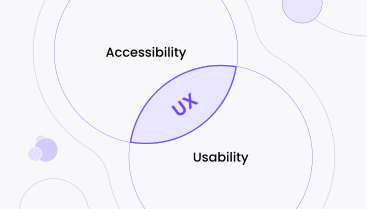
Our approach is based on human-centered thinking, combined with the modern technology effectiveness that represents the future of product design. We reckon on the thorough research, user-centric analytics, and rapid prototyping, so we can verify our hypotheses as quickly as possible. By focusing on effectiveness, usability, and accessibility, we ensure that all our products can withstand the test of time.
Digital product design continues to evolve at this very minute, primarily driven by AI, VR, and other emerging trends. Thus, being flexible and adapting to upcoming changes is the only effective way that allows your product to endure all the challenges. Contact us today if you are ready to build the digital product designs that can become the next technological breakthrough.