 How we use AI in our process


Building Logistics Products
Around Real Operations
Turn complex workflows into clear product logic
Dispatching, delivery timing, warehouse tasks, exceptions, handoffs, and status updates all influence the logic behind a logistics product. Before the interface or architecture is defined, UITOP helps sort out what happens in each scenario, which data is involved, and how the system needs to respond.

Give every role the right information and actions
A dispatcher needs control over routes and assignments, a driver requires task details and status updates, while a warehouse team requests instructions tied to orders, stock, or loading. UITOP uses these role differences to define relevant screens, permissions, actions, and alerts for each user group.
Build for visibility, coordination, and scale
As logistics operations grow, disconnected tools and unclear statuses can slow teams down. We plan products around shared data, connected workflows, and traceable updates, so teams can coordinate daily work and the logistics management software can support more users, locations, and operational volume over time.
Selected Metrics That
Reflect Our Product Experience Work
Our Clients About UITOP’s
Logistics Products Work


Cole Weiler
CEO, BoltWise“They took way more responsibility than we asked and we were so happy with the results of all their work. UITOP was easy to work with, flexible, and valuable to our company.”


Neil Hosey
ResHub, CTO


Dylan Gambardella
Founder, Different Health“They took extra time to ensure that our frontend developer could easily implement the wireframes.”

Sam Jordan
TrovBase, CEO

Dirk Pauw
CEO, Tavas“We’re most impressed with UITOP’s ability to come up with a system to be able to bring design solutions.”

Jordan Girard
Whiterock, Founder

Jake Heimark
Costa Security, CEOu0022We are happy with the improved UI/UX, which has made product navigation cleaner, simpler, and more intuitive. The team is great and always there to help.u0022

Michael Mosseri
Total Brokerage, CEO

Nicolas Endress
ClimEase, CEO
Logistics Product Challenges
We Help Solve
Logistics Product Design and Development
Case Studies

Building one system for warehouses, trucks, and office teams
LogiCore managed warehouse, inventory, and shipping work across 3-4 separate tools. Data gaps, manual entries, and delayed updates slowed daily decisions for warehouse staff, office managers, and teams tracking trucks in transit.
UITOP designed and developed a custom logistics SaaS for warehouse and freight operations. Our team built shipment tracking, warehouse mapping, SKU management, inventory sync, dashboards, and live freight tracking, with Design, PM, Development, and QA involved across the 8-month project. Now, warehouses, trucks, and office teams use real-time data in one system. The platform reached 100% stability under peak-load testing and helped double the speed of daily shipping decisions.

Bringing real-time control to construction fleet management
Activate OS was already used by construction fleet teams, but managers were still reacting too late to downtime risks, service issues, and schedule changes. The product showed data, yet it did not give teams enough operational control.
UITOP joined the project as a long-term R&D team. Our team rebuilt the dashboard, improved the map, upgraded the architecture, and connected equipment, staff, service work, issues, and inspections in one fleet management system. As a result, Activate OS reduced equipment downtime by 24.3% and helped users make decisions 2x faster.

Redesigning a CRM for heavy materials producers
Slabstack created a CRM for concrete, asphalt, and aggregate producers, but the interface made daily work harder than it needed to be. Teams had trouble managing projects, companies, bids, reports, activity, and email in one place.
We handled a full UX/UI redesign for the product. Our team reorganized the CRM around the work producers do every day: tracking accounts, reviewing margins, managing projects, checking activity, and communicating with clients or suppliers. The redesigned MVP launched in 4 months with 156+ screens and 100% design-to-code success. It reached a 97 usability score, helped convert 87% of demos into users, and was later acquired by Sysdyne Technologies.

Why Companies Choose UITOP
for Logistics Product Development


Our Logistics Software
Design and Development Services
Logistics Product Discovery and Strategy
Business processes, user roles, and operational bottlenecks
UITOP studies how orders, shipments, warehouse tasks, approvals, exceptions, and updates pass between people and tools. Our team looks at where work slows down, which roles depend on each other, and which data gaps lead to extra manual effort.
Product scope and delivery priorities
We define what belongs in the first release and what can wait. That includes core functionality, user scenarios, dependencies, delivery risks, and a realistic roadmap, so the project starts with priorities.
Technical requirements and integration planning
Logistics software often depends on APIs, carrier systems, WMS tools, ERPs, customer portals, and internal databases. UITOP reviews these connections, along with access rules, security needs, data sources, and technical limits that may affect delivery.

UX/UI Design for Logistics Software
Role-based workflows for logistics teams
Dispatchers, drivers, warehouse teams, managers, customers, and partners all need different screens and actions. Our team designs user paths based on these responsibilities: assigning routes, confirming tasks, checking stock, reviewing exceptions, or tracking delivery progress.
Dashboards, maps, tables, and status-heavy interfaces
Logistics products often rely on dense screens with filters, statuses, alerts, maps, tracking data, reports, and action buttons. UITOP organizes this information so users can read what matters, act on updates, and follow operational changes with less friction.
Responsive web and mobile product experiences
Office teams may work from desktop dashboards, while drivers and field staff require mobile access for tasks, documents, photos, confirmations, and issue reports. We design connected web and mobile experiences that fit various devices and working conditions.

Logistics Software Development and Integrations
Front-end and back-end product development
UITOP builds the interface, business logic, databases, roles, permissions, and main product functionality behind logistics platforms. Our team works across front-end and back-end tasks, so screens, workflows, and system behavior match the actual operation.
APIs, data flows, and third-party integrations
Carriers, warehouse tools, maps, payment systems, reporting tools, and customer platforms often need to exchange information. We develop integrations and data flows for shipment updates, inventory sync, tracking events, user actions, and external business tools.
Testing, performance, and launch readiness
Before release, logistics software requires checks for edge cases, access rights, data accuracy, heavy tables, map behavior, real-time updates, and security-sensitive workflows. Our QA and development team test the product against the conditions it may face in daily use.

Logistics Product Modernization and Growth
UX audit and product redesign
UITOP reviews existing logistics software to find where users lose time, repeat work, miss updates, or struggle with outdated flows. Our team uses the audit findings to redesign screens, navigation, roles, and task logic with a stronger link to daily operations.
Architecture and feature modernization
Legacy logistics platforms can limit integrations, slow releases, or make new modules hard to add. We assess the current architecture, data structure, and functionality, then update the product in a way that supports new features and business requirements.
Continuous development after launch
After release, priorities usually come from real usage: fixes, analytics, new integrations, workflow changes, extra roles, and scaling needs. UITOP can continue with ongoing development so the product grows with the operation.

Logistics Products We Design and Build
Transportation management platforms
UITOP designs and develops transportation platforms for planning loads, assigning shipments, managing routes, and tracking delivery status. We build products for dispatchers, operators, carriers, who need to stay coordinated from order to delivery.


Fleet and delivery management software
Fleet and delivery products help companies manage drivers, vehicles, daily tasks, route progress, delivery proof, and field updates. Our team can design the role-based screens, mobile flows, status logic, and back-office tools needed to connect drivers with managers.
Warehouse and inventory systems
Warehouse and inventory software covers receiving, storage, stock movement, picking, loading, fulfillment, and inventory visibility. We create products that support warehouse staff on the floor while giving managers and office teams better control over stock, orders, and workload.

Supply chain visibility platforms
We develop platforms for shipment events, exception tracking, partner updates, document access, reporting, and cross-department coordination, where data comes from different sources.

Yard and terminal management products
Busy yards often need dedicated software for gate check-ins, dock scheduling, loading queues, vehicle movement, and location visibility. UITOP can build yard and terminal products that support operators, drivers, and managers across on-site activity.

Logistics portals and operational dashboards
Customer portals, carrier dashboards, manager panels, and internal tools all need different access levels and actions. UITOP designs and builds logistics software solutions for tracking, approvals, alerts, reports, documents, and role-based operational work.

Our Logistics Product Development Process
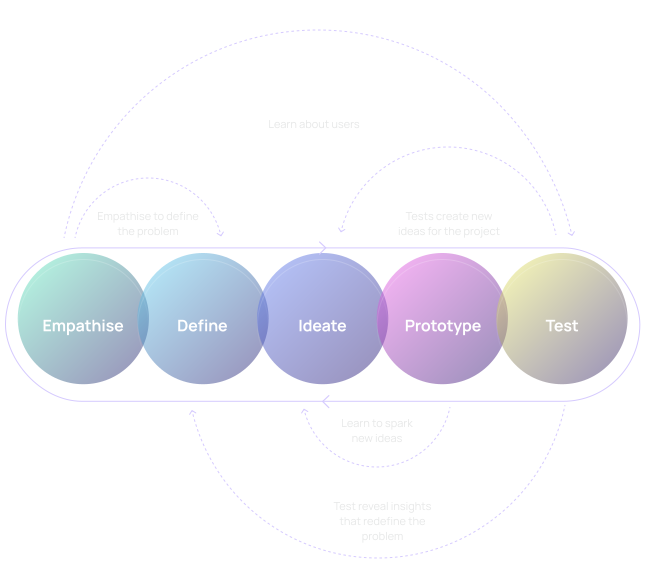
1. Understand operations, users, and business goals
2. Define workflows, scope, and technical direction
3. Design and validate the product experience
4. Build the software and required integrations
5. Test real operational scenarios and prepare for launch
6. Launch, support, and evolve the product
Technologies and Delivery Practices
for Logistics Products
UITOP works with the technologies needed for each logistics product. Our team can prototype core flows, develop the software, connect third-party systems, test operational scenarios, manage releases, and coordinate the work from early planning to launch.


Frequently asked questions
What logistics software development services does UITOP provide?
Our team provides logistics software development services for companies building new products or improving existing systems. This can include discovery, web and mobile development, third-party integrations, testing, launch support, and further product improvements after release.
Depending on the project, we can work on transportation management software, warehouse and inventory systems, fleet and delivery tools, yard products, customer portals, and operational dashboards. UITOP can join at an early planning stage or support a specific part of the project when a client already has an internal team.
Can UITOP design and develop a logistics product from scratch?
Yes, UITOP can start with the raw business idea, existing process notes, user roles, or even a problem your team keeps running into. Then, our team helps decide what the first version needs to include and which workflows need the most attention. Next, we move into UX/UI, development, integrations, testing, and launch, so the product can grow from an early concept into working software.
Can you modernize an existing logistics platform?
Yes, our logistics software development company can modernize an existing logistics platform. Sometimes the product already works, but it has become hard to update, slow to use, or limited by old architecture. In this case, our team can analyze the user experience, user roles, workflows, integrations, and codebase to see what should be redesigned and modernized. The work may include redesigning outdated screens, adding new features, improving API connections, refactoring technical parts, or preparing the system for higher volumes and future releases.
Do you provide UX/UI design and software development as one service?
UITOP can handle UX/UI design and software development within one product team, especially when the project requires close coordination between screens, business logic, integrations, and release planning. This can be useful for logistics software where one design decision may affect permissions, data flows, performance, or mobile behavior. We can also join only one part of the project.
What logistics systems and workflows can you support?
UITOP can support the main logistics systems companies usually rely on: transportation software, fleet and delivery tools, warehouse and inventory products, yard systems, visibility platforms, portals, and dashboards. We can work on one workflow or connect several of them inside a larger logistics product.
Can you integrate logistics software with existing tools and data sources?
UITOP can connect logistics software with the tools your business already uses, like ERP systems, CRM tools, maps, customer portals, reporting services, and more. Our team evaluates what data needs to sync, how often it changes, who can access it, and what happens when an update fails or arrives late. This is essential for shipment statuses, inventory levels, route changes, delivery documents, billing data, and partner communication.
How long does logistics software development usually take?
The answer depends on the scope. The timeline also changes if we are building from scratch or working with an existing system. At the beginning, UITOP reviews the product goals, required features, technical risks, and integration needs. After that, our team can give a more realistic timeline. Contact us for a more specific estimate based on your project.
What happens after the logistics product is launched?
After the product launch, users start working with it, edge cases often appear, and the team sees which flows need optimization or extra detail. UITOP can stay involved with monitoring, bug fixes, feedback review, UX/UI improvements, new features, integrations, and scaling work.