How we use AI in our process
Product, Development
/
Jun 11, 2026
Building a commercially viable software platform is rarely a challenge of pure engineering capacity. The main challenge that modern cloud applications face is invisible. It is the silent divide between product strategy, interface workflows, database architecture, and frontend development. When you treat these core development blocks as independent steps on a traditional linear delivery process, critical context gets lost in transition. Designers may create flows that are not fully aligned with technical constraints; the developer inherits a layout they don't understand; the business suffers the consequences.
A successful application ecosystem is unlikely to scale well as a fragmented collection of independent features. Long-term viability demands a single engineering vision where user behavior directly shapes backend database structures and server-side logic from day one. Embracing an integrated end-to-end product development framework is one of the most effective ways teams can reduce structural friction, stabilize release speeds, and deploy digital products that users actually adopt without manual training.

Explore service
Designing a SaaS product comes with challenges that go far beyond visuals
Contact usTrue digital transformation requires more than localized, short-term software updates. On the ground, many growing software platforms still separate their engineering operations into isolated departments. They hire one outside agency for market research, another team for visual mockups, and a distant third-party vendor for backend database setup. This disjointed execution style creates massive blind spots. You end up with an application that matches your initial paperwork but fails to deliver real, day-to-day value to your users.
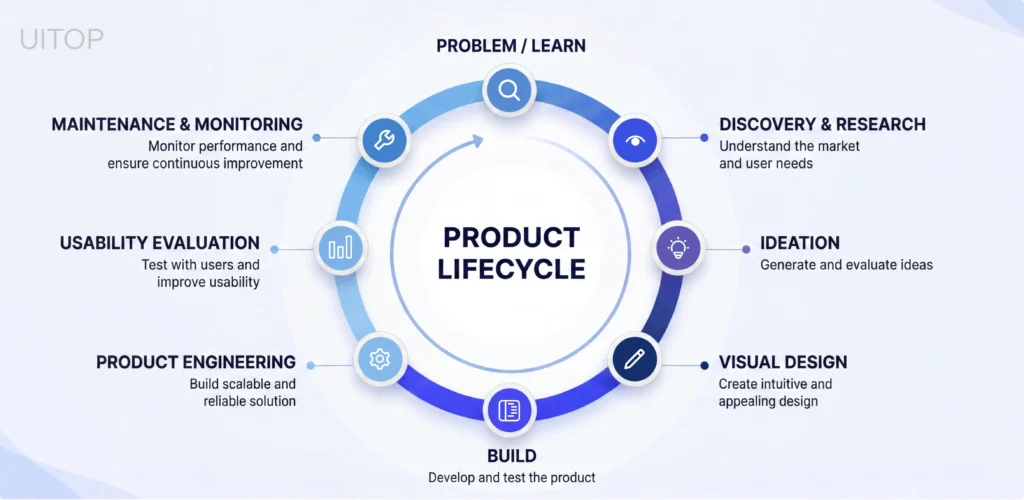
Implementing a complete end-to-end software development approach replaces this old handoff model with a single, highly integrated engineering pipeline. This strategy keeps high-level business goals, customer interfaces, server logic, and automated cloud systems aligned at every stage.
When you unite these practices into a continuous loop, your complete product development lifecycle shifts from a series of stressful handoffs into a flexible, predictable ecosystem. Every engineering hour, database update, and API configuration directly serves a verified human workflow.
The long-term direction of an enterprise software platform is often decided before your engineering leads open a code editor. Building software in competitive industries requires a disciplined discovery phase to validate market assumptions, chart data movements, and isolate the real friction points in a user’s routine. Skipping this foundational step often leaves organizations relying on unverified internal ideas. And this introduces immense financial risk into the future engineering pipeline.
When a development team rolls out features without deep up-front validation, the resulting roadmap may be based on uncertain assumptions. Hidden logical conflicts in your product requirements quickly turn into heavy code issues during later engineering phases. To prevent this costly mismatch, smart business leaders partner with an experienced end-to-end product development partner who knows how to validate assumptions before finalizing system architecture.

The user insights gathered during discovery workshops have to be systematically organized into a practical, clear development strategy. Raw customer interviews, field observation notes, and market research metrics must be converted into prioritized functional requirements, clear sprint goals, and explicit interactive paths. This step translates human expectations into a predictable blueprint for your developers.
This translation process ensures that long-term strategic plans remain grounded in real-world user workflows rather than theoretical features. By grouping user needs into modular functional requirements, product managers can easily prioritize engineering tasks based on expected customer value and technical complexity. This approach helps early development sprints focus on high-impact system logic.
Once the core product strategy is clearly mapped out, your cross-functional teams shift focus toward structural user experience design and active prototyping. This stage is dedicated to outlining complete data layouts, step-by-step navigation flows, and technical wireframes. The goal is to visually define how data moves across the screen before building complex backend infrastructure.
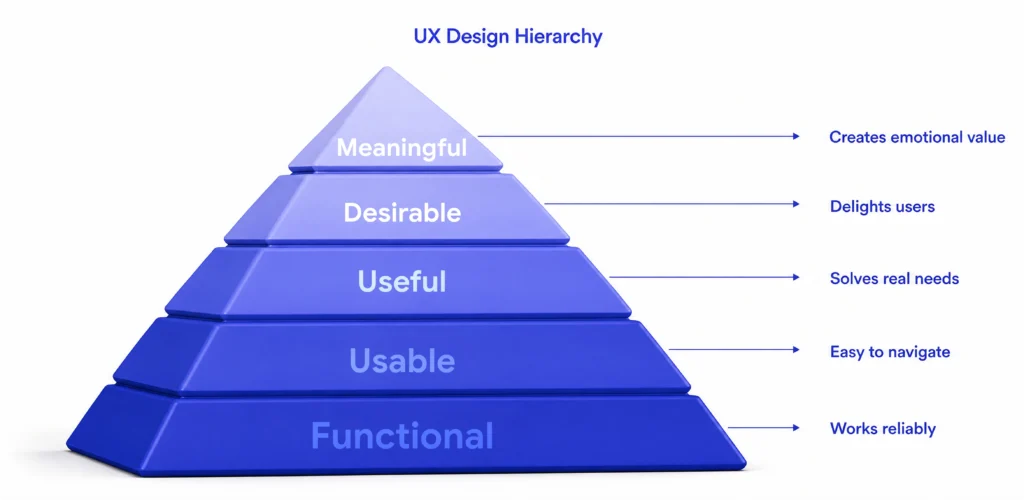
Even well-funded software initiatives frequently suffer from predictable delivery drops during the high-stakes transition from design mockups to live production code.
The most common delivery failures stem from three specific operational gaps:
Overall, this disconnect leads to code overrides, missed delivery deadlines, and unexpected post-release refactoring cycles. Without a single system of truth, the final deployed software often drifts far from the original vision, accumulating technical debt and frustrating users.
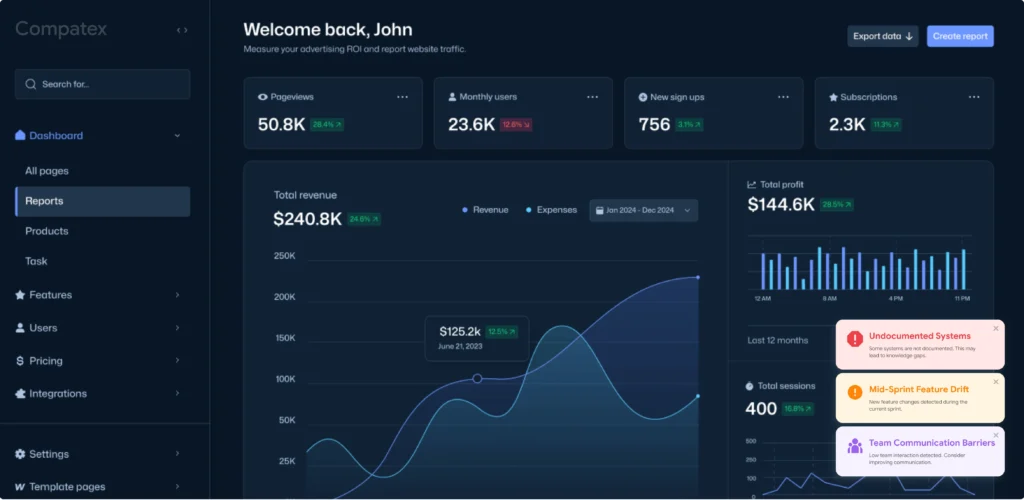
The core structural choices made during early system design phases dictate your platform’s operational limits for years to come. Building a modern platform capable of handling volatile user traffic, massive dataset queries, and ongoing feature updates demands a highly resilient, scalable SaaS architecture mapped out from your very first sprint.
Engineering leaders must carefully evaluate index management strategies, client-side data caching layers, micro-frontend module boundaries, and external API rate limiting rules. Prioritizing modular system design allows teams to update independent software services without risking wide-scale platform downtime. This technical approach preserves your performance standards, minimizes server hosting overhead, and keeps the user experience seamless as your business grows.
Maximizing engineering output means replacing old, independent handoffs with a continuous cross-functional collaboration model. Product managers, visual designers, software architects, and QA engineers must collaborate continuously from the very first project kickoff. This ensures that all technical constraints are accounted for long before finalizing the product design process for SaaS products.
At UITOP, we achieve great business results by keeping our teams connected through daily meetings and constant communication. Our designers and developers discuss system constraints early on and use a component-based design approach to ensure technical feasibility. This process eliminates unexpected reworks, speeds up time-to-market, and helps protect our clients' budgets.
When you combine early user experience validation with disciplined architectural planning, you drastically lower the need for post-release software overhauls. Resolving complex data-handling challenges during the early wireframing phase protects your development timeline and ensures optimal performance before systems hit production.
A clear example of this connection is how our team engineered an enterprise-grade SaaS system for LogiCore, an international logistics provider, ensuring a robust, scalable SaaS architecture from day one. The system needed to process and display massive quantities of global logistics records without experiencing interface slowdowns or server data synchronization drift.
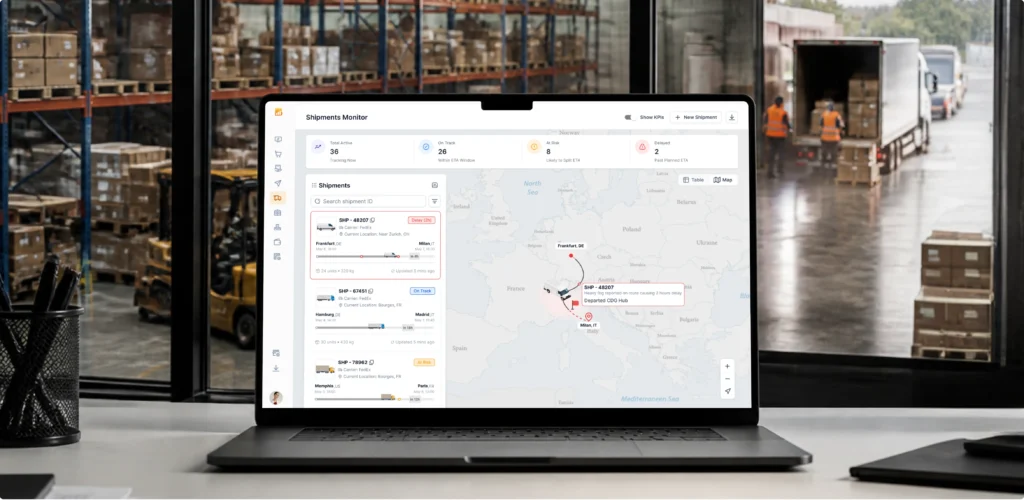
We built the full platform and backend infrastructure from scratch, creating an enterprise-level SaaS system. To maintain strong performance while displaying thousands of real-time shipment records, our team implemented the shipment tables with TanStack Table, combining server-side pagination with row virtualization to preserve performance while rendering large live datasets.
Our team maintained real-time data accuracy, status badges, and ETA drift indicators by storing API responses in Zustand and refreshing them through background polling logic. Our engineers also improved data processing efficiency by using PostgreSQL window functions to calculate week-over-week KPI metrics directly within the database, reducing the need for intensive frontend calculations.
Additionally, we developed expandable location trees with lazy loading, using Prisma ORM dynamically. This approach keeps the initial page payload limited to a flat 100 rows, regardless of how deep or complex the full data structure becomes. Finally, our team used Recharts to create the order status charts and stored the formatted chart data in Zustand, allowing users to instantly regroup metrics without triggering another server request.
Moving a cloud application from a raw launch version to a high-volume enterprise system is a significant balancing challenge. As your customer base grows, new feature requests increase quickly. If you want to keep your screen response times quick and your core infrastructure stable, you need continuous scalable SaaS architecture planning.
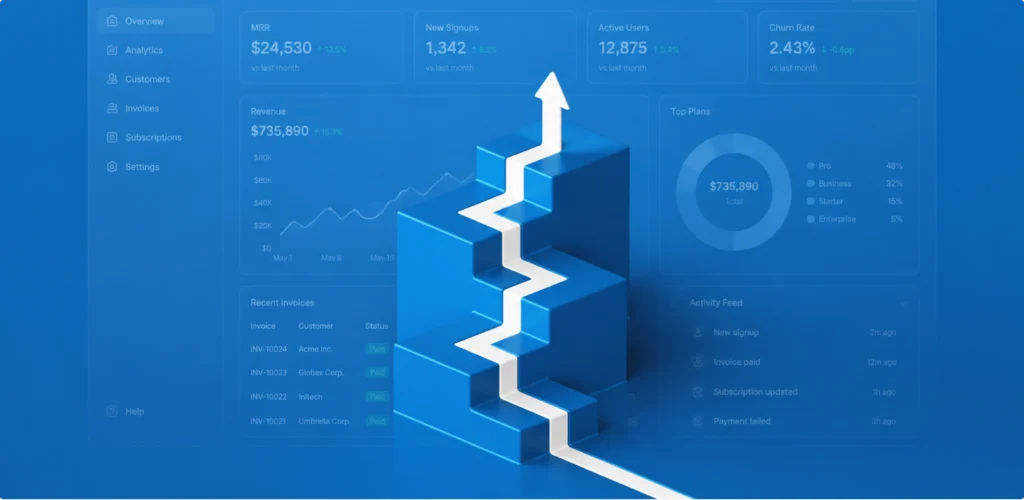
To manage this growth phase without major system instability, you have to lean on automated testing pipelines and clear component boundaries. New feature updates must plug in cleanly. If adding a new notification module risks breaking your payment page or corrupting main database tables, your architecture may be too tightly coupled. This disciplined, decoupled approach keeps user paths predictable and ensures you aren't wasting your entire budget on server maintenance as your traffic scales.
Discuss project
Need a SaaS UI/UX partner focused on product growth and business outcomes?
Contact usIn practice, the software industry is moving away from fragmented agency networks. Savvy tech founders recognize that splitting a project between a research firm, a design studio, and a distant development vendor is a major delivery risk. It inflates your budget, delays your launch, and weakens the original product vision. Winning a mature market demands a cohesive, modern UX-first product development approach where your user workflows and backend code choices are designed together.
As an established leader in this space, UITOP provides this complete integration by housing design and development under one roof. It completely removes the traditional handoff friction, allows us to check technical feasibility early, and ensures your software is structurally ready to grow.
Building a scalable, high-performing software platform requires treating your product as a single, connected ecosystem. Strong product outcomes are more likely when user research, interface layouts, backend infrastructure, and automated delivery pipelines function as a unified system. When you get your designers and developers talking from day one, you build an application that is naturally ready to grow.
If your software team is currently struggling with slow feature releases, brittle code, or constant friction between design and dev teams, it's time to fix your production lifecycle. Unifying your design and engineering processes under a single strategic partner allows you to eliminate delivery risks and optimize your development budget. Reach out to UITOP today to book a technical consultation, and let's begin your product development the right way!
It’s an integrated engineering process that handles the entire software lifecycle, from initial market discovery and user research through interface design and backend programming to final cloud deployment, under one continuous process.
The full cycle shifts systematically through upfront product discovery and user validation, interface layout design and interactive prototyping, backend architectural blueprinting, live software compilation, and automated production scaling.
Discovery pressure-tests core business assumptions before investing heavily in expensive backend code. This phase uncovers critical user requirements and prevents teams from building features that fail to deliver real-world value.
Your underlying system design strongly influences your application’s performance limits. A modular, well-indexed database framework prevents interface lag and keeps your cloud hosting bills predictable when user traffic spikes.
Rework is typically triggered by poor cross-team communication, a lack of unified project documentation, and disconnected design handoffs. When developers receive unvalidated visual mockups without technical context, they are forced to write complex patches that inevitably require a costly refactoring cycle later.