How we use AI in our process
Product, Development
/
Jun 11, 2026
If you're building a CRM, an analytics platform, or an internal operational tool that hundreds of people will rely on daily, picking a development partner is one of the decisions that will either hold your product together or quietly undermine it for years.
The challenge is that most web app development companies look the same from the outside. Same tech stack slides, same case study carousels, same promises about scalability. This guide is about how to read past that.
Before getting into how to choose a company, it's worth being clear on what you're actually dealing with, because complex SaaS development is a genuinely different category of work.
A standard web project has a predictable scope: pages, components, a CMS, an API connection or two. But a complex SaaS platform operates differently from day one.
You're managing multi-tenant architecture, where dozens of client organizations share infrastructure but must never see each other's data. You're handling role-based access control across user types with fundamentally different permission levels. You're building dashboards that pull from multiple data sources in near real-time and stay readable under load.
Then add enterprise workflow requirements: approval chains, conditional logic, audit trails, integrations with Salesforce, SAP, or a custom internal system a client has been running since 2014. These systems often don't tolerate shortcuts.
This is exactly why choosing a development partner for a complex SaaS platform is a different process than hiring a web agency. You're not evaluating whether they can build. You're evaluating whether they've built at this level of complexity before, and what they learned from it.
When you're evaluating web application development companies for a complex SaaS project, experience with system complexity is the first thing that separates the relevant candidates from the rest. Specifically, experience with:
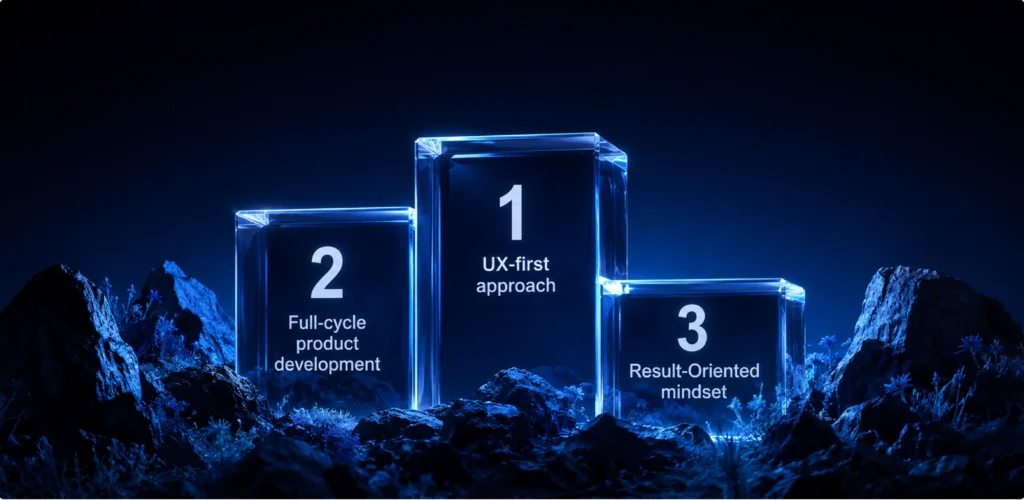
UX competence matters here too, and it goes well beyond visual design. In complex SaaS, UX is largely about information architecture: how you present 40 data points on a single screen without losing the user, how you design workflows that enterprise users will actually adopt.
Good UX on a complex platform is invisible. But bad UX kills adoption regardless of how solid the backend is.
Last but not least, a product-focused mindset. Strong development partners think about what the product needs to become. They ask about your growth plans. And they flag architectural decisions that would limit you later.


Explore our web app development services
We build complex web applications with scalable architecture, enterprise integrations, and user-focused experiences designed for long-term growth
Learn moreWhen assessing development companies, it's tempting to focus on the technology stack. React or Vue, Node or Django, AWS or GCP. These are visible, easy to compare, and any competent team will have opinions on them.
Architecture is harder to see. It's the set of decisions that can determine how your system holds together over time:
Here's where you often see it. Two teams using the same stack can produce very different results depending on the architectural decisions they made in month one. A system built without clear data modeling, without planning for integrations from the start, can start to calcify. What should take days may start taking weeks, because every new feature requires untangling what came before.
Within 18 months, a poorly-architected system may become more expensive to maintain than to rebuild. That's often the real cost of choosing a team based on their stack rather than their architectural thinking.
💡 Pro tip: Ask your shortlisted companies this directly: "Walk me through a time an architectural decision at the start of a project affected what was possible 12 months later." A team that can answer this question in detail is worth a longer conversation.
Clutch ratings are a reasonable place to start. A high score confirms the company communicates well and delivers on time. You can also read the actual reviews and look specifically for clients who were building in your complexity category. If you see several reviews from enterprise SaaS or data-heavy platform projects, that's a more relevant signal than a high rating alone.
Case studies can bring you closer to a real answer. Projects in your complexity category are also what play a role: multi-role enterprise systems, platforms with heavy integration requirements, and data-intensive dashboards. A portfolio of mostly marketing tools and e-commerce websites may indicate the team hasn't worked at this level yet.
Before a single line of code is written, most of the important questions about your product should already be answered:
A development team that treats discovery seriously will spend time on these questions. They should push back on assumptions and map out requirements you hadn't considered yet. This process typically takes two to four weeks and produces a specification detailed enough that the actual build can start without constant back-and-forth.
A shorter discovery process usually means these questions are answered later, during development, when changing direction costs more.
Complex SaaS platforms can have dozens of data points on a single screen, multiple user roles, and workflows that differ depending on who's logged in. The UX challenge here is about how all of this information is organized and how intuitively a user can move through it.
Thus, examples of dashboards or admin panels they've designed for non-technical users are more useful than their visual portfolio. The decisions behind those interfaces, how they handled density, hierarchy, and workflow, show how the team actually approaches the problem.
Complex SaaS platforms don't stay still after launch. They evolve based on user feedback, expand into new markets, add integrations.
So, it's worth asking directly what your potential service provider’s typical post-launch engagement looks like and whether they have capacity for ongoing product development. Some development companies are structured mainly around delivery. They hand off the product and move to the next project. Others can stay involved through ongoing product iterations.

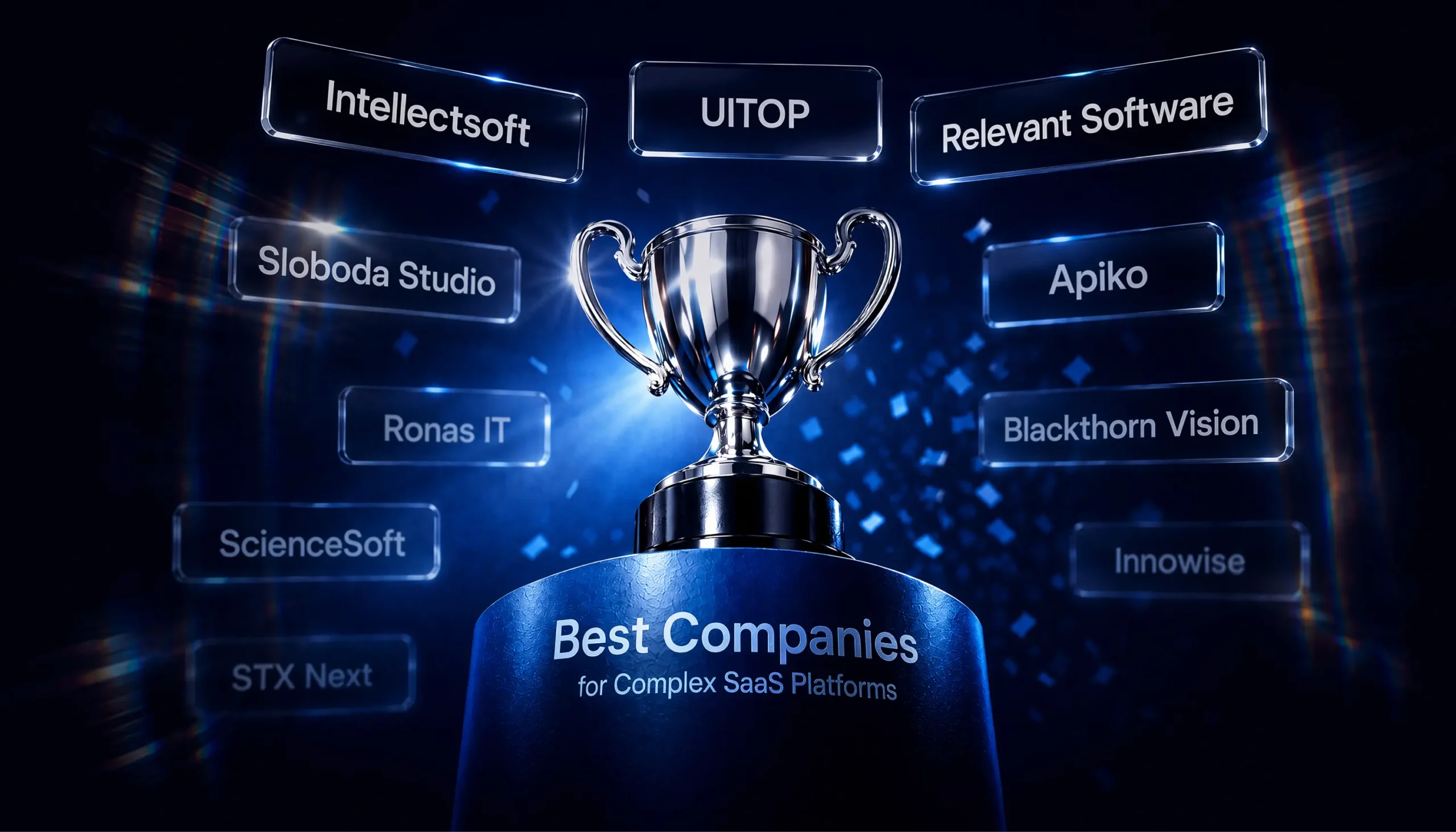
We researched a range of web application development companies and put together this list of 10 based on their Clutch rating and real experience with complex SaaS projects. Here's who made it.
Intellectsoft has been building enterprise software since 2007. Their services cover strategy consulting, CX design, engineering, lifecycle management, and system integration through what they call their IS360 framework. In 2024 alone the company received over 16 awards, including Top Custom Software Development Company by FirmsTalk and Top App Development Company by Business of Apps.
The AF Gruppen case study gives a good picture of the kind of work they do. AF Gruppen is the third-largest civil engineering and construction company in Norway, with $1.6 billion in revenue and over 3,800 employees.
Their legacy systems were fragmented across departments, so Intellectsoft built three interconnected solutions on a single platform: a labor management portal with scheduling and real-time reporting, a project management system with an on-site inspector app, and a mobile tool for truck drivers managing asset delivery.
Cirrus Insight, a SaaS product that extends Salesforce CRM to mobile, worked with Intellectsoft to build a native app connected to their existing Salesforce platform via a private API.
Intellectsoft has 43 verified reviews and a 4.9-star rating. A 2025 reviewer, director of project management at a global youth culture agency, described the team as "collaborative, communicative, and proactive." Another noted they’re "always prepared to go the extra mile."
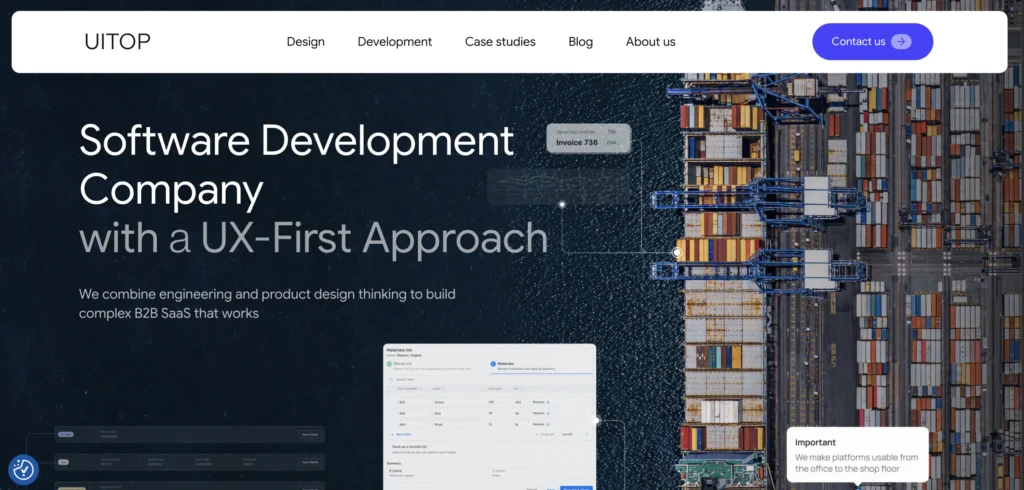
UITOP was founded in May 2021. Five years in, the team has grown to an experienced team with over 60 completed projects. Almost every project in their portfolio is complex B2B SaaS: ERP systems, CRMs, fintech platforms, data-heavy dashboards, internal operational tools. UITOP provides both custom web application development services and UX/UI design services under one roof, so that user flows, information architecture, and backend decisions are worked out together from day one.
UITOP’s technology stack is built around modern, reliable tools for scalable web and mobile products. The team works with TypeScript, Node.js, Next.js, NestJS, Express, React, Angular, React Native, Python, Ruby, and Ruby on Rails, choosing the right technologies for each product’s goals, architecture, and long-term growth.
A significant share of the company’s work is rebuilding existing systems. They take platforms with accumulated technical debt, slow performance, and fragmented architecture and turn them into scaling solutions. One accounting SaaS client had transaction speed improved by 37% after UITOP's performance optimization work. Another client raised a $21M Series A round on a product UITOP had designed and built.
SLABSTACK, a construction industry ERP, is one of their projects. After UITOP's engagement, it gained recognition as the most intuitive software among major concrete associations in its category. Valocore found product-market fit from v1 and was later acquired.
Their Clutch profile has 21 verified reviews with a 5 rating. One reviewer described how UITOP caught assumptions early that the client had missed themselves. Jordan Girard, founder of Whiterock, said: "We're most impressed with UITOP's ability to come up with a system to bring design solutions."
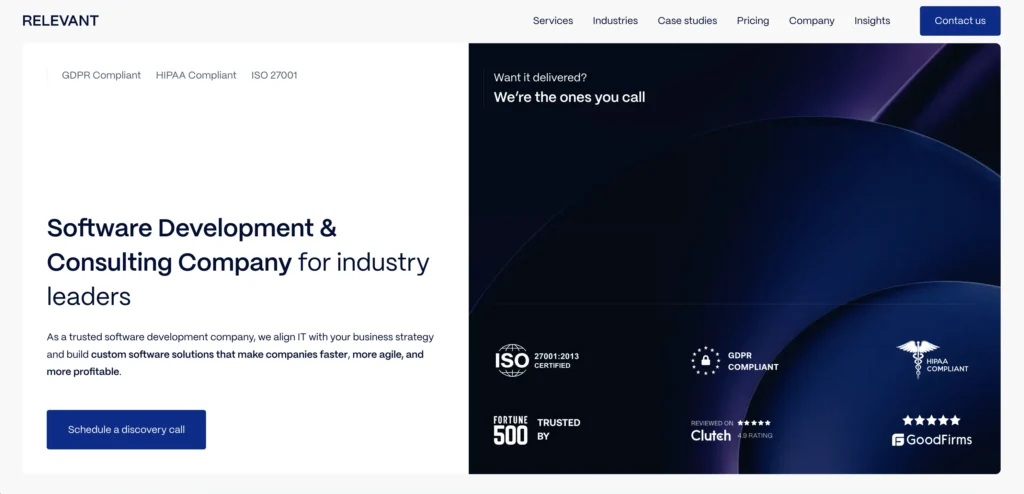
Relevant Software was founded in 2013 and works with clients across the UK, Germany, the Netherlands, the US, Australia, and several other markets. 246 projects delivered over 12 years, with a 98% client satisfaction rate. 92% of the team is senior-level, and employee retention is 96%. The company is ISO 27001 certified, GDPR and HIPAA compliant, and an AWS partner.
Their service offering covers the full development lifecycle: SaaS development, AI and machine learning, IoT, data management, cloud, web and mobile development, DevOps, and cybersecurity. Relevant Software also offers dedicated team and staff augmentation models for companies that need to extend their engineering capacity.
The industries the firm focuses on tend to involve regulatory complexity or high data volumes. FinTech and Healthcare clients. The case studies on their website are filterable by industry, tech stack, and outcome, which makes it easier to find relevant projects before the first conversation.
Kaizo, a customer support performance SaaS from Amsterdam, is one of their more detailed published projects. Kaizo needed a frontend built from scratch: complex dashboards with heatmaps, histograms, and multiple chart types simultaneously, tight Zendesk API integration, and over 50 KPI visualizations.
The product launched as the number one WFP and gamification app on the Zendesk marketplace, made Forbes' Top 25 ML startups list, and operates across 82 countries. Agent engagement went up 30% post-launch. CEO Dominik Blattner said, "Relevant's team helped us transform a concept into a scalable, gamified experience. Their front-end performance tuning made a clear difference."
Sloboda Studio has been building web products since 2010. Over 15 years, the team has grown to 100+ specialists and delivered 200+ projects, mostly for startups and SMBs in Europe and North America. Two of Sloboda's founders are real estate entrepreneurs, which shaped an early specialization in property and marketplace software that has since expanded into FinTech, MarTech, and Travel.
Their technical core is Ruby on Rails and Python. Companies building data-heavy platforms, marketplaces, and FinTech tools tend to find a good fit here. Sloboda’s clients are Veeqo, an omnichannel retail platform for merchants that lets businesses manage orders and track inventory across multiple warehouses; CityFALCON, a financial news aggregator that raised over $6M; and Salita, a B2G and B2C marketplace for interpreting services built by Sloboda from the MVP stage.
Salita is probably the most detailed long-term story on their website. The platform now has over 1,700 interpreters, connects users from 72 countries, and supports 67 languages. Gautam Chandna, Salita's CEO, described the partnership this way: "Sloboda Studio's quality and breadth of talent secured a long-term partnership. They've helped catalyze an eightfold growth in revenue annually."
Across all their marketplace clients, Sloboda has helped raise more than $20 million in investment. Three engagement models are available: end-to-end software development, dedicated development team, and staff augmentation. The firm has 53 verified reviews on Clutch.
Apiko was founded in 2014 and has grown to a team of 100+ professionals. The industries they focus on tend to involve operational complexity: manufacturing digitalization, facility management, logistics and supply chain, construction software, and FinTech.
Beyond writing code, their service model covers the full cycle: discovery phase, custom software engineering, SaaS development, AI and ML integration, Cloud and DevOps, and application modernization for teams dealing with legacy systems.
Eric Typaldos, Co-Founder and CTO at Hive, described the cooperation with Apiko this way: "They actually care about the product and being a part of the team, which is hard to find in contractors. Apiko is emotionally invested in the project 100% of the time." Hive, a project management SaaS, went on to raise $28M and was featured in Forbes.
ThinkNet GmbH is one of their longer-running client relationships. Apiko built four separate products for them across different industries: Pro.Con, a shop management SaaS for mobile phone retailers; Planwerk, a project and task management platform for construction firms; YuuHR, an HR management system designed for construction companies; and ThinkNet itself, a SaaS subscription management tool that administers customers across the other modules. The engagement is ongoing.
Good Life Sorted, a marketplace connecting elderly people with helpers for household tasks, saw sales increase 650% in the six months after Apiko joined the project, during the COVID-19 period.
Ronas IT was founded in 2007 and has been operating for 18 years. 1,500+ projects delivered. 60% of their clients come back for more work. The team has 50+ full-time developers, which they see as a foundation for consistent code quality and internal standards.
Their work has been recognized on multiple occasions. Two Awwwards Honorable Mentions, two Behance UI/UX Gallery features, a GoodFirms Top Mobile App Development Company award, and a Design Rush Best App Design Award.
The tech stack centers on PHP, Laravel, React, React Native, PostgreSQL, Docker, and TypeScript. Ronas IT industries span FinTech, Healthcare, Logistics, Real Estate, Marketplace, Retail, Travel, and Education.
Their development practices follow secure-by-design principles and privacy by default, which matters for clients building products that will launch across multiple markets with different regulatory environments.
Here’s one quote from the company’s client: "Ronas IT helped us double the number of users year over year. They are efficient, responsive, and professional. They ensure that the platform is well maintained." Their Clutch profile has 34 verified reviews with Premier Verified status.
Blackthorn Vision was founded in 2009. 75% of employees are at senior or middle level, 70+ long-term projects have been completed, and the average client engagement duration is 5+ years.
The company positions itself as an AI-enabled product engineering partner with deep Microsoft and .NET expertise. Their technical stack covers .NET, Java, JavaScript, React, Flutter, Azure, AWS, and Google Cloud. Services span the full product lifecycle: product discovery, business analysis, web and desktop development, mobile, cloud migration, SaaS development, application modernization, QA automation, and machine learning and AI integration.
Their industry focus carries specific compliance and architecture demands. Healthcare work involves HIPAA and GDPR. Oil and gas clients need solutions handling complex operational data and equipment monitoring across distributed field environments. Biotech clients need software integrated with medical workflows and sensitive data handling.
One of their Clutch-verified engagements started in 2015 and has exceeded $1 million in total investment, with the partnership still ongoing. The client's technology, built with Blackthorn Vision, has been deployed in public installations including Two World Trade Center, Penn Station, and the Washington, DC subway system.
ScienceSoft was founded in 1989, which is 36 years of operation, 750+ experts, 4,200+ projects across 70+ countries and 30+ industries. Some of the company’s clients are Walmart, eBay, NASA JPL, IBM, T-Mobile, Nestle, Baxter, Ford, and PerkinElmer.
The recognition track record is substantial. Financial Times named ScienceSoft among America's Fastest-Growing Companies five years in a row. IAOP included them in the Global Outsourcing 100 for the fifth consecutive year. Newsweek listed them among America's Most Reliable Companies in 2025. On top of that, CRN included the company in the Solution Provider 500. Additionally, ScienceSoft holds ISO 9001:2015, ISO 27001, and ISO 13485 certifications, carries Microsoft Gold Partner status with competencies across Application Development, Data Analytics, Data Platform, Cloud, and Messaging, and holds AWS Select Tier Partner status.
Around 50% of their developers are at the senior level. Overall, their engineering teams span software engineers, IT consultants, data scientists, and cybersecurity engineers, covering end-to-end digital initiatives.
Services cover the full stack: custom software development, web and mobile development, SaaS development, AI and ML, data analytics and business intelligence, cloud engineering, application modernization, software testing, cybersecurity, and managed IT. For SaaS specifically, their team can take a product from MVP launch, which typically takes one to four months, through to full-scale release with major updates every two to four weeks. On Clutch, ScienceSoft has 41 verified reviews and 4.8 stars.
Innowise was founded in 2007 and has grown into a company of 3,500+ engineers with delivery centers across Europe, the US, and the Middle East. 1,600+ projects delivered for 400+ clients across 70+ countries. 93% of clients stay with the company for over 12 months.
The service list is broad: web and mobile development, custom software, cloud engineering, DevOps, DevSecOps, embedded software, legacy modernization, mainframe support, AI and machine learning, data engineering, business intelligence, ERP and CRM development, cybersecurity, IoT, and staff augmentation. The technology coverage matches: React, Angular, Vue, Java, .NET, Python, PHP, Golang, Ruby, Node.js, iOS, Android, Flutter, AWS, Azure, GCP.
The Innowise client list includes NTT DATA, the Commercial Bank of Qatar, and SPAR. The Qatar bank case study is worth reading. The client had been experiencing a decline in corporate account applications and needed a more secure digital onboarding process with KYC and AML compliance. Innowise built a digital banking web form that streamlined the account opening process and addressed the fraud prevention requirements.
Recognition track record: Inc. 5000 at No. 554 among America's fastest-growing companies, IAOP Global Outsourcing 100 inclusion, and IAOP Excellence in Strategic Partnerships award. That last award was given for VOKA, Innowise's own MedTech product. VOKA 3D Anatomy & Pathology is a medical visualization platform used by 1,000,000+ users across 190 countries that won the 2019 World Summit Award in the Health & Well-Being category and has been integrated into the academic curricula of several medical universities.
Their Clutch profile carries Premier Verified status with 72 reviews at 4.9 stars. One reviewer described the collaboration directly: "The Innowise team is able to implement new features faster than our internal team would be able to."
STX Next was founded in March 2005 in Poznań, Poland, starting as an 8-person company built around Python. Twenty years later, they've grown to 500 professionals, delivered 1,000+ projects for 300+ clients, and describe themselves as Europe's largest Python-focused digital engineering partner. STX Next supports clients mainly in the US, UK, DACH region, and Poland.
Over time, the company’s Python backend roots expanded into JavaScript, then product design, then test automation. In 2020, STX Next shifted toward Data and AI/ML, building expertise in Snowflake, Databricks, and Apache Iceberg, with AWS and Azure as their primary cloud partners. By 2022, they had moved into Generative AI, building a suite of AI development services.
If you’re developing complex SaaS platforms that need to handle large-scale data, integrate AI workflows, or modernize legacy data infrastructure, STX Next offers engineering depth across the full data and AI stack, combined with a long track record of production delivery. Hogarth Worldwide has been their partner since 2013. Other clients include Mastercard, Decathlon, Google, and Wayfair.
STX Next has been named to the Clutch 1000 two years running, which places the firm in the top 1% of agencies on the platform globally. Their Clutch profile carries 101 verified reviews with Premier Verified status. One of STX Next’s clients said: "They have a well-honed, agile delivery process. The other element that really complements that is they are incredibly strong in design."
You may have noticed that several SaaS web app development agencies on this list offer both UX design and engineering under one roof.
Good UX for complex systems requires engineering decisions that happen early. If a designer works separately and hands off a mockup, the engineer may discover that access states weren't accounted for in the data model, or that the configurability imagined would require rebuilding a core module. The team either ships a degraded version or loses weeks. This is exactly where a UX-first development approach pays off.
At some point in almost every complex SaaS project, the scope expands beyond what was originally scoped. Your platform needs to connect to the CRM. Finance wants it synced with the ERP. Plus, the client asks about a Stripe integration, then a BI tool, then an internal service built five years ago with no documentation.
This is just how enterprise software works. The question is whether your development team has done this before. So, when you're evaluating a development partner, it's worth asking which of these systems they've worked with and what problems they ran into.
Scaling issues rarely appear during development. They appear six months after launch, when the user base grows and parts of the product that worked fine under light load start causing problems.
At this point, fixing it means working on a live product with real users, which is a different situation than building from scratch. The teams that avoid this tend to think about scale during architecture. Not by over-engineering the MVP, but by making data modeling and infrastructure decisions that don't create problems later.
UX is part of this too. Filters, bulk actions, and role-based views are much harder to add retroactively than to include from the start.
What else matters, beyond the tech stack and team size, is how a development company thinks about your product.
Some teams take a ticket, build what's in it, and close the sprint. But no one on the vendor side questions whether the feature is solving the right problem or whether there's a simpler way to get the same result.

Other teams ask these questions. They own the end-to-end product development process the way an internal team would. And products built by teams that think this way tend to have fewer features that nobody uses, less technical debt from decisions made in a hurry, and better adoption after launch.
When design, development, and product expertise are spread across different vendors, context tends to drop between them. This is partly why some companies specifically look for a full-service product company. One team that covers design, engineering, and product thinking, without coordination overhead between vendors.
UITOP is this kind of company. They describe their approach as UX-first development, which means design and engineering work together from the start. The agency supports the full product lifecycle, from discovery and UX through engineering and post-launch support, so you're working with one team across the entire process and don’t have to coordinate between several. Their product design services for SaaS platforms cover everything from information architecture and user flows through to the final interface, with engineering involved throughout
UITOP has built MVPs that scale without requiring a full rebuild. Getting the architecture right the first time, at a stage when requirements are still unclear and timelines are tight, is one of the harder things to do in product development.
On top of that, the company handles the integration work that comes with complex SaaS platforms: CRMs, ERPs, internal services, third-party tools. This is part of their standard scope.
Build your complex SaaS platform with us
Looking for a high-performance web application that integrates seamlessly with your business logic and scales with your growth?
Contact usThe companies on this list were selected because they've demonstrated experience with the kind of complexity that makes SaaS development hard: multi-role systems, enterprise integrations, data-heavy interfaces, products that need to work for hundreds of users with different needs and permissions.
Picking from a list like this still requires doing your own evaluation. Look at their case studies for products similar to yours in scope and ask about their discovery process. You also need to find out how they've handled integrations with the specific systems you use.
If you're building a complex SaaS platform and want a team that handles UX, engineering, and product thinking together, reach out to UITOP!
A web development company is a company that builds software running in a browser. The term covers a wide range, though. Some companies focus purely on writing code to a spec, while others handle the full product lifecycle, from discovery and architecture through UX, engineering, integrations, and post-launch support. When you’re building a complex SaaS platform, that difference matters quite a bit.
The most useful thing you can do is look at what they’ve actually developed. It’s also worth getting on a call and asking how they handle situations where they disagree with a client’s product decision.
The scope of what can go wrong is larger. You’re dealing with role-based access across multiple user types, integrations with systems like Salesforce, SAP, or Stripe, dashboards that need to perform under real data volumes, and enterprise workflows that often differ from client to client. A feature that works fine in isolation may behave completely differently once it’s connected to five other systems and used by 500 people simultaneously.
It varies depending on scope, team location, and seniority. Among the companies on this list, hourly rates range from $25 to $99. A focused MVP with a senior team typically starts around $50,000. Once you’re adding complex integrations, multi-role systems, and enterprise-grade infrastructure, the numbers can go up from there. The discovery phase, if the company offers one, usually gives you a much clearer picture of what your specific project will actually require.
Because the decisions made in the first few weeks tend to follow you for years. The way data is modeled, how services communicate, how permissions are structured – these aspects may feel like implementation details at the start. Yet, later, they’re the reason a new feature takes three weeks or why the product slows down when a client onboards a larger team than expected. This is why it’s crucial to ask a potential development partner how they think about architecture before the code is written to understand whether they’re thinking beyond the current sprint.