 How we use AI in our process

Design, Product, Development
/
Apr 25, 2026

Healthcare is a domain where design carries weight well outside aesthetics. A misplaced button, a confusing label, or a delayed system response may lead to consequences that affect real lives. In this environment, UX is tightly connected to safety, accuracy, and responsibility.
While in other digital products, friction can cause users to leave an application or website, in healthcare applications, it can lead to misdiagnosis, delayed therapy, or even improper handling of personal data. Hence, the primary objective of UX design within the healthcare industry is to develop interfaces and analyze systems as a whole.
Healthcare product design requires seeing the interface as one layer within a larger structure. Beneath is a web of roles, workflows, human expectations, and compliance restrictions. The objective is usability and reliability under real-world circumstances.


Service overview
Need a healthcare design partner who understands complex systems and regulations?
Contact usMedical products have an operating environment defined by the sensitivity of data, compliance issues, and costly errors.
Medical records hold highly sensitive information. It needs to be stored securely while also being accessible when needed by the appropriate personnel. Regulations like HIPAA and GDPR establish how data can be used, disclosed, and viewed. These rules have direct implications on interface design, interaction models, and software architecture
In healthcare settings, stability becomes very important. An outage may simply cause user frustration in regular SaaS solutions, but could actually impede healthcare services in medical applications.
Accountability is another point that distinguishes one from the other. All activities within a healthcare setting should be identifiable and accounted for. The user should trust what they see and do based on the information.
Healthcare software product development involves factors such as clarity and predictability. This is to ensure that all activities within the healthcare facility are done successfully.
Healthcare systems comprise various parties with distinct goals, behaviors, and constraints. A one-size-fits-all approach causes miscommunication and a lack of efficiency. Successful healthcare UX design should be flexible enough to account for these distinctions and aid in the everyday activities of each party involved:

These roles connect within one product, yet their needs differ. Effective digital health UX reflects these differences and aligns the experience with real responsibilities.
Design can play an integral part in minimizing errors in the field of healthcare. Accuracy, safety, and reliability are the primary objectives for every interaction. Interfaces must assist users in taking appropriate action and make it difficult for them to take the wrong action. Clear labeling, consistency, and well-designed flow assist users in taking appropriate action without fear. Feedback in context informs the user about what’s going on.
Preventing errors requires anticipation of real-life situations. Lack of data, repetition, or even the wrong choice is a regular case. A sound system recognizes such instances promptly and issues instructions. Through validation and warnings, this allows for user assistance without hindrance.
The way data is organized is another factor that contributes to accuracy. Information must be visually accessible, allowing comparison and verification.
Working closely with engineering on design enhances these results. There are many safety mechanisms in place at the system level, where logic and interfaces operate in tandem. Experienced teams in SaaS product development and design are able to efficiently incorporate their methodologies in healthcare settings.
Designing for safety means enabling safe behavior while eliminating risky activities, thereby acting as a protective factor.
Healthcare processes rarely follow a straight path. A single patient journey may include diagnostics, medical record management, treatment planning, and ongoing data handling. Each of these stages depends on specific systems, specialists, and interactions.
Diagnostics involve interaction among laboratories, diagnostic equipment, and clinicians. Medical record management requires accuracy and consistency throughout all operations. Data management is ongoing, starting from patient registration and ending with the monitoring of outcomes. It creates a dense, interconnected structure where even small inefficiencies can cause disruptions.
The lack of order in such workflows leads to inefficiencies. Users may have to use multiple applications, perform duplicate tasks, and overlook crucial information.
Healthcare product design aids in organizing this complexity. The process begins with detailed mapping of real activities and interactions. Bottlenecks, unnecessary tasks, and user-friction spots are all identified by designers. After that, digital interactions are matched to how tasks actually take place in real life.
The above relationship will be made possible using structured interface designs. The user can perform their tasks confidently if they follow a particular sequence of actions, statuses, and data types. When systems are linked, repetitive work and user inputs become unnecessary.
The design of any product needs to be based on its environment. It is common for health workers to be interrupted while working, under stress, and have to handle vast amounts of information.
Healthcare solutions work under tight regulatory environments like HIPAA and GDPR. From an underlying level, such regulations set rules for data collection, storage, access, and sharing. They create boundaries that protect users and guide system behavior.
Regulatory compliance impacts decisions on interaction design. It affects aspects that are visible as well as invisible.
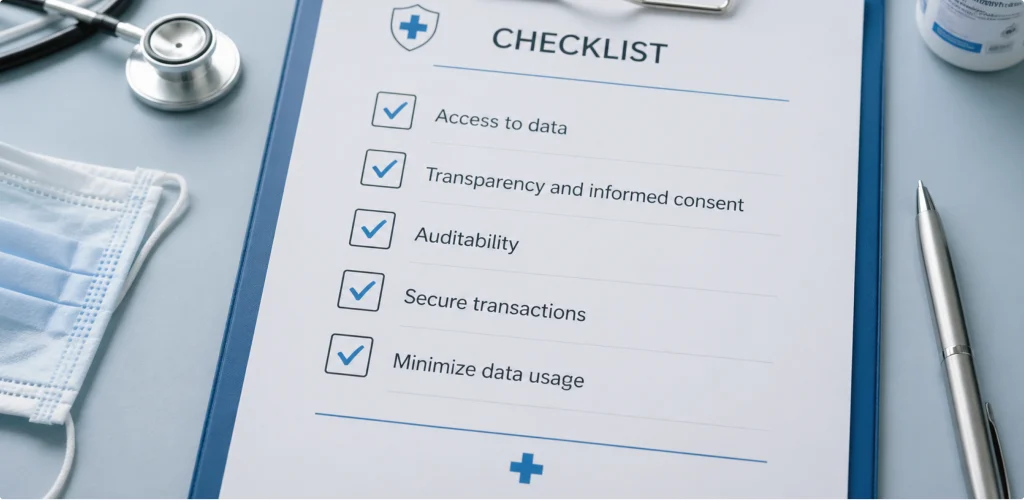
All actions must be deliberate and accountable. By incorporating these values into the UX design of health applications, one will develop a product that enables its users to know what happens to their information and trust its use.
Products in the healthcare industry cater to people who differ in terms of ability, skill level, and mood state. Accessible healthcare UX design ensures that anyone is able to use the product without any obstacles.
This can be achieved through proper visual organization. Texts should be easy to read, while color contrasts should be significant and layouts predictable. User interactions should remain straightforward, allowing people to perform tasks without additional effort.Cognitive load should also be minimized in healthcare systems. Medical professionals deal with many factors simultaneously. User interfaces should feature relevant information and organize it in an understandable way.
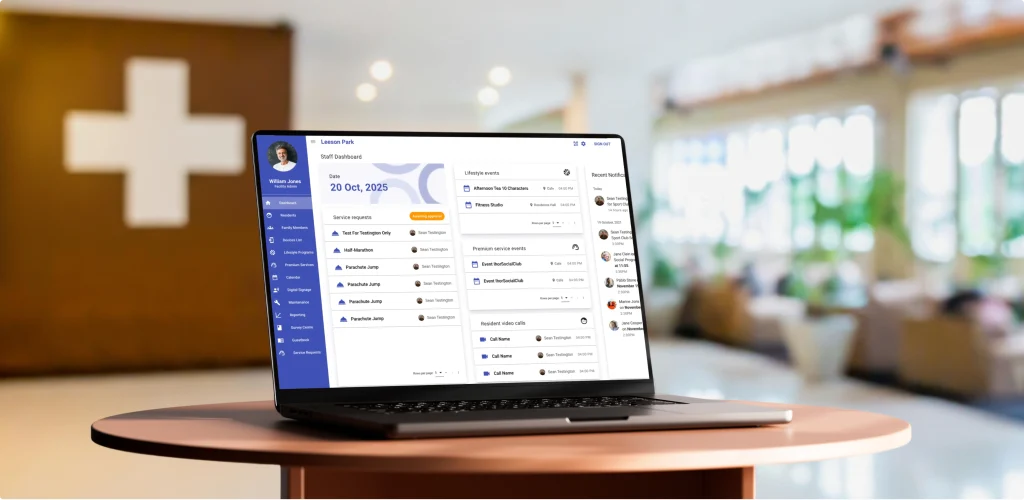
An example is our ResHub client, a medical workforce management platform that we helped redesign.
It turned out that the medical workforce had problems obtaining timely information about their patients. For this reason, we designed a dashboard where all necessary information could be viewed at once, helping the staff focus on providing better care to patients. In addition, we designed the calendar more clearly so that there were fewer issues with missed appointments.
Additionally, we designed for people with Alzheimer’s disease. The app takes into consideration the way individuals with such diseases interpret and react to the environment around them. The UITOP team took care to make sure that users are able to interact with buttons in a manner similar to how they would interact with real-life objects.
The result was impressive: an ease of use score of 89 and 87% user retention.
There are several UX practices that can be used to enhance reliability and create trust in a healthcare system. They ensure that users get through important activities while minimizing the risks of errors. The main UX principles include:
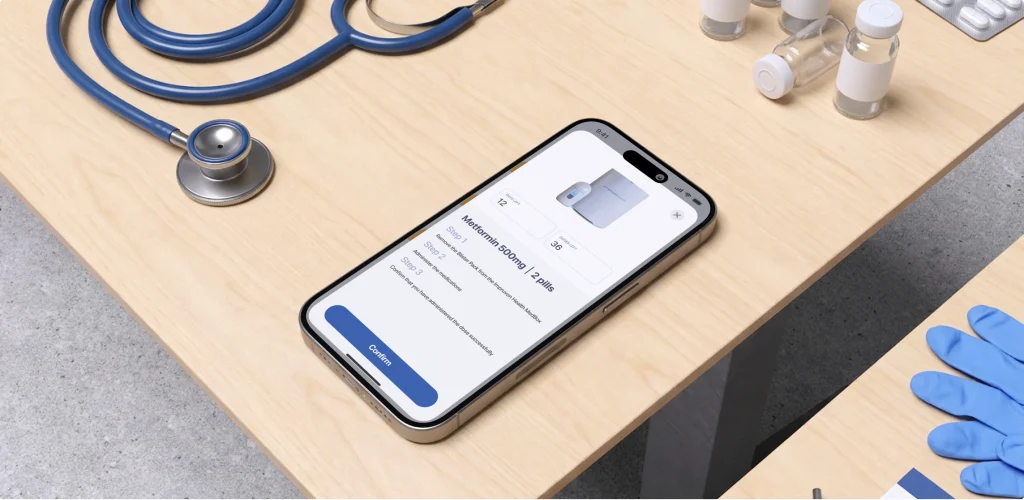
Impruvon Health, our client’s platform, is an illustration of what happens when such UX patterns are implemented into a product. We designed an application for patients that assists them in monitoring their medication and communicating with doctors. Here’s what has been done:
As a result, a high score of 92 and a 93% customer retention rate were achieved. People become accustomed to the interface and begin to trust the system when product design healthcare patterns are consistent.
There is always close collaboration between design and development. Healthcare software product development implies a systemic approach in which UX drives architecture and vice versa.
In other words, each of these aspects is highly interconnected. Any UX decision determines how the product functions on an architectural level. On the flip side, any engineering constraint dictates the way in which interactions should be created.
An effective design process includes such factors as scalability, system integrations, and maintenance. Many healthcare products are integrated into some kind of platform. These might include electronic health records or hospital systems.
However, these products tend to be dynamic as well; laws change, there are innovations in features, and the requirements of users. Desig should take these aspects into account, allowing the system to develop further without disturbing any existing processes.
Healthcare product design services providers can assist, as they consider user needs, but they also take the technical aspect into account from the very beginning.
Design is an integral part of development. It always goes hand-in-hand with development, influencing its performance.

The product design healthcare faces common difficulties along with fintech, CRM, and enterprise applications. The sectors have similar pain points affecting their UX design approaches:
Solutions from these domains bring proven approaches that support clarity and control.
Lessons learned about UX in regulated systems point out the impact of design with high levels of restrictions.

Knowledge gained within multiple fields boosts the UX for digital health. Proven methods enable professionals to create reliable systems.
Errors in healthcare UX spread across processes and decision-making, creating confusion where clarity is critical.
First, at the level of interaction, a poorly defined interface can easily lead to error-prone activities such as incorrect input, selection, or omission. In healthcare settings, even the smallest mistake can lead to disruptions in decision-making.
Second, problems related to data handling will introduce additional layers of risk. Specifically, when user feedback fails to guide proper interpretation of information provided by systems or if the data itself becomes unavailable, workflows become discontinuous.
The weakening of trust is inevitable if these issues persist. Physicians can turn to manual measures and stop relying on the system. Patients may be reluctant to interact with a digital solution. With time, trust disappears, and a product fails to integrate into the patient’s routine.
From the business angle, each of these factors has significant consequences. Operational inefficiency results in cost growth. Poor data management practices lead to compliance issues. Bad experience undermines reputation and reduces adoption speed.
A lot of these negative impacts could be prevented with proper design at an early stage. For instance, failing to take usage realities into account, simplifying workflows, or omitting user validation often produces vulnerable systems.
Solid product design in the field of healthcare solves these problems by building reliable and user-friendly systems.
Healthcare product design centers on building complex systems where every element responds to real-world conditions.
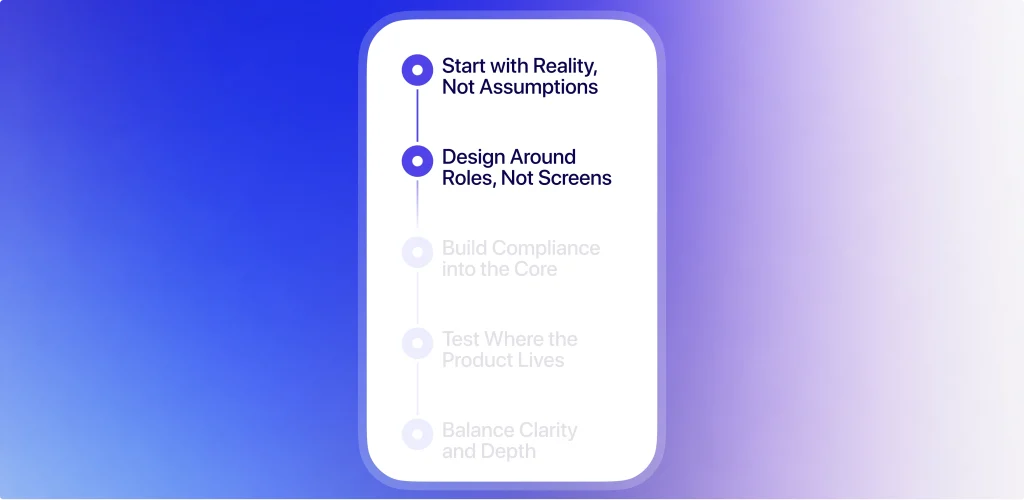
With constant interruptions, time pressure, and a fast pace, healthcare environments require a design that supports quick decisions and helps users return to their tasks without friction.
The structure of information varies for different users within the same application, where doctors need speed and efficiency, patients expect simplicity and reassurance, and administrators rely on control and clear insight.
This determines the movement and the accessibility of the data involved and should be considered from the very beginning because incorporating them early in the design process leads to seamless interactions rather than complications further down the road.
Controlled environments rarely reflect real pressure, so products need to be tested in settings with noise, stress, and constant interruptions.
Users need to have access to relevant information, which shouldn’t take too long to find. At the same time, they may sometimes need to go beyond simple facts.
When all of these aspects are taken into account, the result is an intuitive product that fits seamlessly into the user’s daily routine.
What we deliver
We design healthcare interfaces that balance compliance, clarity, and patient needs
Contact usAt its essence, the design of digital health user experience is all about accountability.
Product designers working within the realm of digital health UX create products that affect decisions, behaviors, and results. They serve professionals, instill confidence in patients, and make sure that systems operate effectively.A sophisticated view of product design for healthcare realizes this accountability. It reflects a view of design that includes aesthetics, functionality, and performance under stress. For healthcare providers, design is a partner in their work. If done well, it takes a back seat to let users concentrate on what really counts. At UITOP, we know how to do well, as our team has extensive experience in healthcare design. Whether you have a startup idea or consider redesigning your existing product, contact us! We’re here to deliver a solution with a high ease of use score.
Healthcare UX involves multiple user roles, strict compliance requirements, sensitive data, and high-stakes decisions. These factors create a layered environment where design must support accuracy and reliability.
Start by mapping real-world workflows and understanding how different roles interact. Design should align with these processes, reducing friction while maintaining necessary detail.
Compliance ensures that systems handle data securely and meet legal requirements. It directly influences interface design, user flows, and data management practices.
Digital health UX focuses on designing user experiences for healthcare products. It combines usability, safety, and systems thinking to create solutions that work in complex medical environments.

