How we use AI in our process

Design, Product, Development
/
Jul 25, 2026
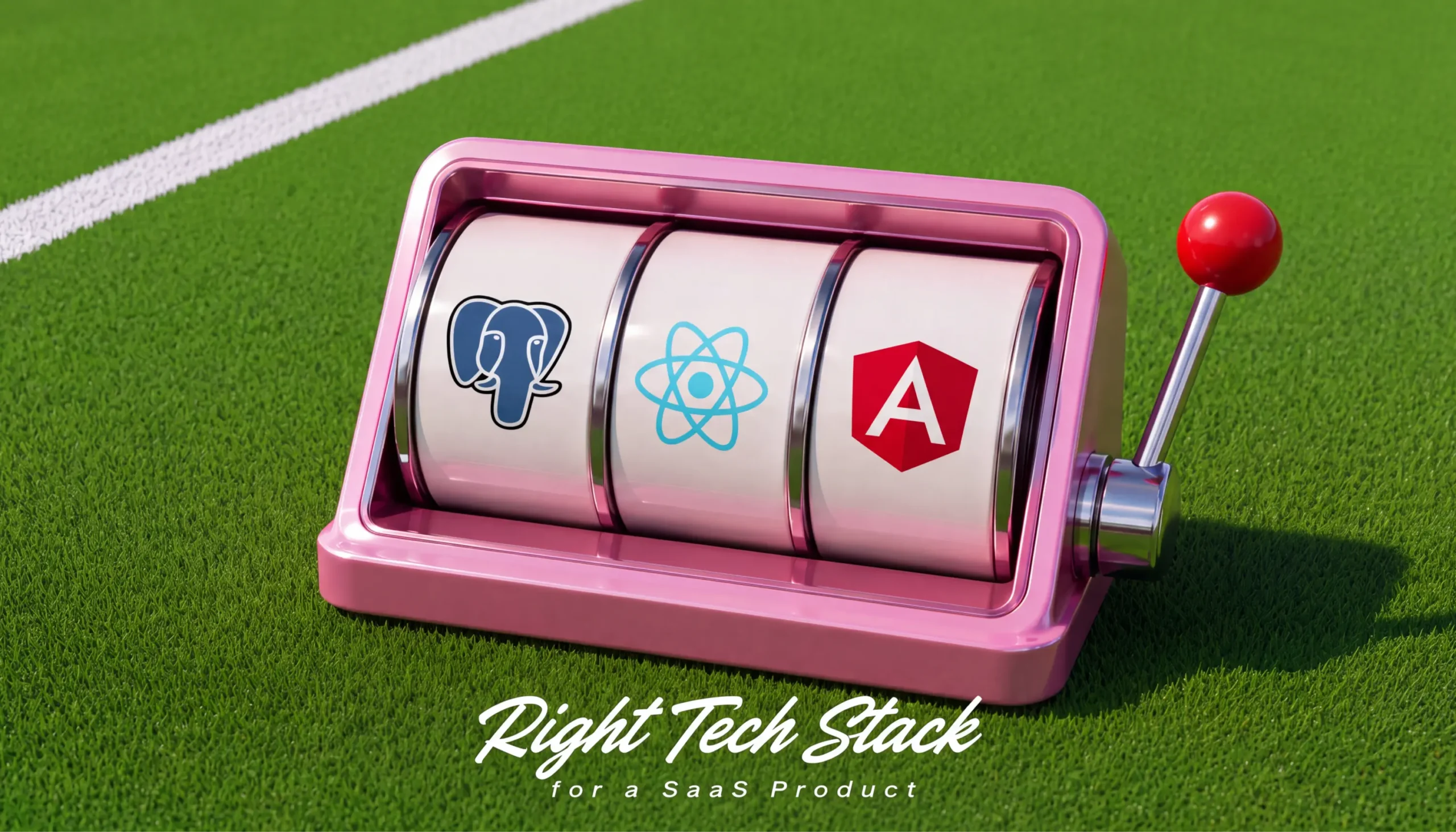
Every SaaS founder asks the same question sooner or later. What tech stack should we choose? At first, it sounds like a purely technical discussion. React or Angular? Node.js or Ruby? PostgreSQL or MongoDB? In reality, these questions come much later.
But your tech stack influences almost every stage of your product's journey. It affects how fast you can launch, how quickly you can roll out new features, how much your infrastructure costs, and how smoothly your product scales as your user base grows. Some decisions will stay with your product for years. Get it wrong, and you'll start feeling the negative impact sooner than you expect.
That's why your tech stack deserves just as much attention as your business model or product roadmap.
The challenge is that there is no perfect stack.
A healthcare platform has very different requirements than a CRM. A marketplace scales in its own way compared to an analytics platform. Even two products in the same industry may need completely different architectures because their business goals are different. Copying another company's stack rarely works here.
So where do you start? Let's look at the factors that really shape a good tech stack, from business goals and user experience to architecture and scalability.
Developers are usually the first people involved in tech stack discussions, and for good reason. They know the tools, frameworks, and programming languages better than anyone else.
But those choices affect much more than SaaS development. They influence product direction, delivery speed, maintenance costs, and the experience customers have with your software.
Imagine you're building software for small businesses. Your biggest priority may be launching quickly and collecting customer feedback.
Now imagine you're building software for banks. Security, compliance, and reliability suddenly become much bigger priorities than shipping features every week.
The same framework could work for both products. But the architecture, infrastructure, and development priorities would look completely different because the products are solving different business problems.
The SaaS tech stack should support business goals instead of limiting them. Think about it this way. Your stack becomes the foundation of your product. If the foundation matches your plans, every future improvement becomes easier. If it does not, every new feature becomes more expensive than it should be.
So, before diving into frameworks, make sure you have a clear picture of the product you're building and what it is trying to achieve.
The next step is turning those business goals into technical requirements.
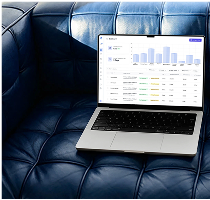
Build a stack that fits your goals
A solid tech setup helps you ship fast today and keeps things easy to grow tomorrow
Contact usInstead of jumping straight into frameworks, spend some time understanding what your product actually needs.
A few conversations at this stage can save weeks or even months of development later. Once you have a clear idea of where the product is going, the technology choices become much easier.
Start with the basics:
The answers will naturally narrow down your options.
Take a learning platform, for example. It might need video streaming, progress tracking, assessments, and different user roles. An analytics platform cares much more about processing huge amounts of data quickly. A CRM has its own focus, with customer records, reporting, permissions, and automation at the center of the product.
They're all SaaS products, but they solve different problems. That means they have different technical needs.
It's also worth thinking beyond your first release. The MVP is only the starting point. If the product succeeds, what comes next?
Maybe customers will ask for a mobile app. Enterprise clients might expect SSO. Partners could want API access. AI features may move from the roadmap into the product much sooner than expected.
You don't need to build all of that at once. But keeping those possibilities in mind makes it easier to choose technologies that can grow with the product instead of getting in its way a year down the road.
People often talk about a tech stack as if it were one thing. It is actually a collection of technologies working together. Each layer solves a different problem and the overall success depends on how well those layers fit together.
A modern SaaS stack usually includes:
Each layer affects the others. A fast frontend won't solve problems caused by a slow database, and scalable infrastructure can't compensate for an architecture that wasn't designed to grow.
A strong SaaS tech stack comes from making technologies work well together. Every decision should support your product, your roadmap, and the experience you want to deliver to users.
Many founders think about frameworks before they think about software architecture. Experienced teams usually do the opposite.
Imagine building a small CRM. At first, one application handles everything. Authentication. Reporting. Notifications. Customer management. This works perfectly.
Then the product grows. Customers ask for integrations. Reporting becomes more advanced. Background jobs increase. AI features appear. The product starts serving thousands of companies. Suddenly, the original architecture begins to feel crowded.
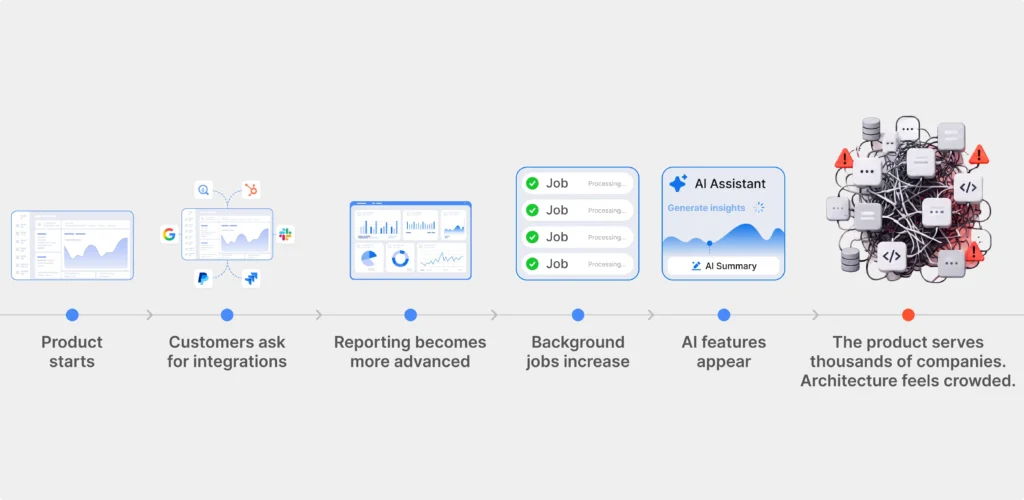
The first version of your architecture is a starting point. The key is making sure it has enough flexibility to support growth from the beginning.
That is why many successful SaaS products start with a clean modular structure. It keeps development simple while leaving room for future expansion.
Architecture also affects development speed. A well organized system is easier to understand. New developers become productive faster. Testing becomes easier. Releases become more predictable. Maintenance costs stay under control. Teams spend less time understanding dependencies and more time building new functionality.
Security benefits as well. Authentication, permissions, encryption, and audit logs become easier to manage when the architecture has clear boundaries.
Technology choices should support the architecture you've designed and help it evolve as the product grows.
The best framework cannot compensate for weak system design. On the other hand, strong architecture gives your product room to evolve without constant rewrites. As your SaaS grows, that flexibility becomes one of your biggest competitive advantages.
One of the biggest mistakes teams make is assuming that every SaaS product has similar technical needs. Even if two companies both sell software on a subscription model, the challenges they solve can be completely different.
Take a CRM platform, for example. Most of the work happens around managing customer data, generating reports, and supporting different user roles. Performance matters, but predictable data handling and permission management often matter even more.
Now compare that to a marketplace. Besides managing products and users, it also has to support payments, search, messaging, recommendations, and transactions between multiple parties. The architecture has to handle constant activity without slowing down the experience.
Analytics platforms come with another set of challenges. Their users expect dashboards to load quickly, even when millions of records sit behind every chart. That usually means the product needs efficient data processing, optimized queries, and infrastructure that can scale as datasets grow.
Learning platforms combine content delivery, user management, assessments, reporting, and collaboration features. Their infrastructure should support different learning formats and growing content libraries.
The same goes for industry specific SaaS products. We saw this while working on Slabstack, a CRM platform for the construction industry. At first glance, it looked like another business management system. In reality, it had to bring together CRM workflows, project management, financial reporting, document handling, and day to day operations in a single workspace. That meant thinking beyond individual features and designing a product that felt simple despite its complexity.
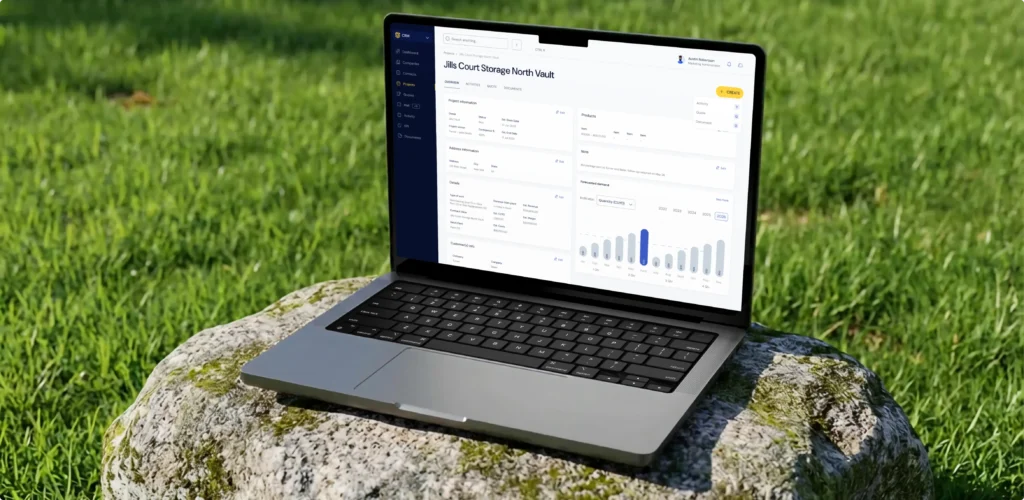
So, the team redesigned the entire product experience around how concrete and asphalt producers actually work. Features like interactive financial dashboards, integrated email workflows with PDF previews, and a Kanban board for tracking bids all introduced different technical requirements that had to be considered from the start. The result was a modular product that reached MVP in just four months, achieved a 97 usability score, and was later acquired by Sysdyne Technologies.
Healthcare, fintech, and logistics products each add another layer of complexity. Compliance, security, real time updates, and third party services become essential parts of the product instead of optional features. Those requirements should influence your tech stack for SaaS long before the first line of code is written.
There's no universal tech stack because no two products are exactly alike. The better you understand what you're building, the easier it becomes to choose technologies that can support it as it grows.
Every founder hopes their product will grow. Ironically, many products are built as if they never will.
A product that serves a hundred users behaves very differently from one serving one hundred thousand. More users generate more requests, more data, and more background jobs. At some point, the architecture that felt perfectly reasonable during the MVP stage may begin to show its limits.
Planning for scalability ahead gives your product room to grow from the very beginning. A clean architecture, modular services, and flexible infrastructure make it much easier to add new features without rebuilding the platform along the way.
Growth changes the product in many ways. As your customer base expands, the product usually becomes more complex too. Enterprise clients may ask for SSO. New markets introduce different compliance requirements. Your roadmap may grow to include AI features, mobile apps, or public APIs. Every new capability places additional demands on the system.
SaaS architecture plays an important role here. A scalable architecture allows different parts of the application to grow independently. Your reporting service may need more resources than authentication. Your search engine may experience heavier workloads than your payment system. Keeping those responsibilities separate makes future improvements much easier.
Scalability is also about your development team. As more engineers join the project, they should be able to work without constantly blocking one another. Clear boundaries inside the codebase make collaboration faster and reduce unnecessary complexity.
Very few SaaS products work on their own anymore. Customers expect software to fit naturally into the tools they already use.
Think about the average business application today. It might connect to Stripe for payments, Google or Microsoft for authentication, Slack for notifications, HubSpot or Salesforce for customer management, and several analytics platforms. Some products also rely on AI services, document storage, accounting software, or marketing automation tools.
Each integration comes with its own technical requirements. Some APIs are modern and easy to work with. Others have rate limits, outdated documentation, or unexpected limitations. Ignoring those differences early can create unnecessary development work later.
Each integration comes with its own technical requirements. Some APIs are modern and easy to work with. Others have rate limits, outdated documentation, or unexpected limitations. Even well known platforms can surprise you. While working on Pacioli, for example, we integrated with QuickBooks and saw firsthand that even a market leader's API can behave unpredictably. That's why it's worth planning for different scenarios from the start.
Each integration comes with its own technical requirements. Some APIs are modern and easy to work with. Others have rate limits, outdated documentation, or unexpected limitations. Even well known platforms can surprise you. While working on Pacioli, a healthcare accounting & tax platform, we integrated with QuickBooks and experienced it ourselves that even a market leader's API can behave unpredictably. That's why it's worth planning for different scenarios from the start.
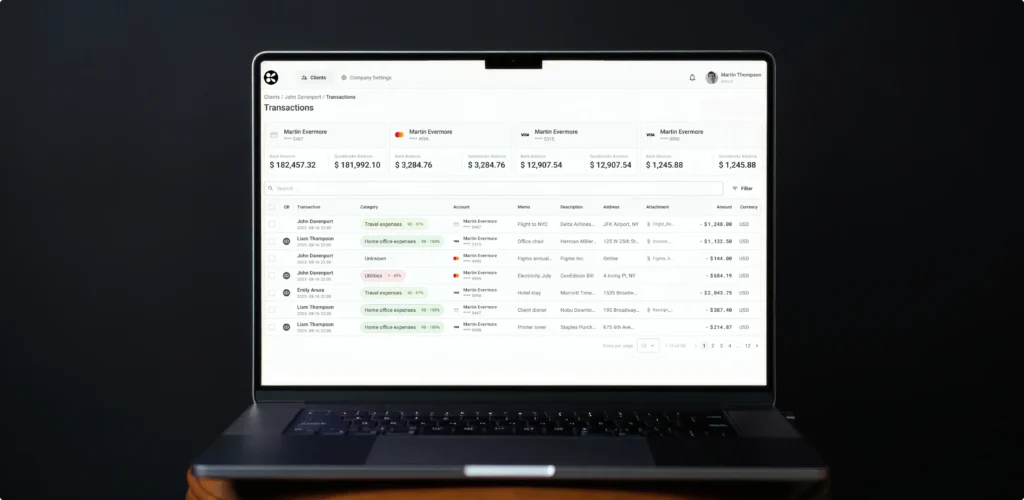
Pacioli also had to connect to Canadian banks through Flinks while supporting CSV uploads for offline records. Instead of handling those as separate workflows, we built a single processing pipeline that applies the same categorization logic to both. From the user's perspective, everything works the same way, regardless of where the data comes from. On top of that, AI powered expense categorization, custom rule management, and a secure React Native mobile app all had to work together as part of one connected ecosystem. Today, the platform provides 97% live data coverage across Canadian financial institutions while maintaining 100% consistent categorization across both live and imported records.
It's also worth thinking beyond your first release. The integrations you need today are rarely the only ones customers will ask for. Enterprise clients often have their own ecosystems, and they expect your product to fit into them. Planning for that early gives you far more flexibility later.
One more thing that's easy to overlook is monitoring. APIs change, access tokens expire, and third party services occasionally experience outages. Building monitoring and error handling into your architecture helps your product stay reliable, even when an external service runs into problems.
As your product grows, so does the number of connections it depends on. A well planned integration strategy gives your team the flexibility to keep expanding the platform without turning every new integration into a major engineering project.
Ask five engineering teams about their favorite technology, and you will probably get five different answers. That is completely normal.
Technologies become popular because they solve certain problems well. They are not meant to solve every problem equally well. That is why trying to find a universal winner usually leads nowhere. Every technology has its strengths, and the best choice always depends on the product you're building.
Here's how some of the most popular technologies are commonly used in modern SaaS products:
| Technology | Often used for | Why teams choose it |
|---|---|---|
| React | Interactive web interfaces, dashboards, admin panels, customer portals | Component based architecture makes complex interfaces easier to build and maintain |
| Node.js | APIs, real time features, notifications, collaboration tools, backend services | Handles many simultaneous connections well and supports fast product iteration |
| Ruby | SaaS platforms, business applications, MVPs, internal tools | Mature ecosystem and rapid development make it a strong choice for products that grow quickly |
In our experience, writing code in Node.js and Ruby feels different, and Ruby developers are harder to find today. However, both options let your product grow easily and are simple to support over time.
Choosing a technology for web application development is rarely about following trends. Product requirements, team experience, hiring plans, and long term maintenance all play an important role in the decision. The strongest products usually come from a stack that fits the business, the roadmap, and the people building it.
Every startup wants to launch as quickly as possible. And that makes sense. The sooner your product reaches real users, the sooner you start learning what they actually need.
The problem begins when speed becomes the only metric your team considers. The choices you make during those first months often shape how easy the product will be to improve later. A shortcut that saves a few days now can easily turn into weeks of extra work a year later. A rushed release may look successful on launch day, but maintaining that codebase becomes more challenging as the product grows.
Technical debt usually builds up little by little. One quick workaround becomes another. Temporary solutions stay in production longer than expected. Eventually, adding a simple feature requires touching parts of the system that nobody wants to modify.

When you're building an MVP, every decision is a trade off. Some features can wait. Some corners are worth cutting. But if your product succeeds, will your current foundation support another year of growth? Or will your team spend the next six months rewriting what was built during the first three?
Teams that keep moving quickly over time usually have one thing in common. They invest in a foundation that's easy to build on. That makes it easier to release new features, spend less time dealing with maintenance, and focus on solving real customer problems instead of cleaning up old code.
Choosing a tech stack often sounds like an engineering decision. In reality, design has a big impact on the technologies your product will need.
Think about the products you enjoy using. Pages load quickly. Search feels instant. Dashboards update without delays. Real time collaboration works as expected. That kind of smooth experience comes straight from smart, intentional tech choices behind the scenes.
Take a reporting dashboard as an example. Users expect to filter data, switch between views, and customize charts without waiting. To make that happen, developers need to think about database performance, caching, and how the frontend handles large amounts of data.
The same goes for other features. A chat tool needs real time communication. A learning platform with hundreds of videos needs a reliable way to deliver content. An analytics platform needs to process and display large datasets without slowing down.
That's why designers and developers should be involved from the start. Product ideas are easier to shape when both teams work together. Developers understand what's technically possible, and designers understand which interactions matter most to users.
We've seen this in many projects. Sometimes a small change to the user flow makes development much simpler. In other cases, understanding technical limitations helps designers create better solutions that feel more natural to users.
This way of working is often called a UX-first development approach because user experience helps shape technical decisions from the very beginning. When design and development move in the same direction, teams can build products that are easier to improve, faster to develop, and more enjoyable to use.
Choosing technologies before understanding the product is like planning a trip without knowing the destination. You may choose a direction. You may even start moving. But eventually, you will probably need to change your route.
This is where a proper product discovery phase becomes valuable.
Discovery helps teams understand what they are actually building before development begins. It combines user research, business analysis, technical evaluation, and product planning into one process.
During discovery, teams answer important questions like:
These answers create a much clearer picture of the technology requirements.
For example, a founder may initially think they need a simple dashboard. After talking with users, they discover that customers need advanced filtering, automated reports, and integrations with existing tools. That changes the technical direction completely.
Discovery also helps avoid expensive surprises. Changing a button color after development is easy. Changing the entire architecture because the product requirements were misunderstood is much more expensive.
A good discovery process creates alignment between business owners, designers, and developers. Everyone understands the goals, priorities, and limitations before implementation starts.
This makes technology decisions more intentional. Instead of choosing tools because they are familiar, teams choose them because they support a clear product strategy.
Getting your MVP out into the world is a big step. It's also the point where the real work begins.
If people start using your product, it will change. New customers will ask for features you didn't plan for. Your roadmap will grow. You may enter new markets, release a mobile app, introduce AI capabilities, or start working with enterprise clients. Every new step brings new technical requirements.

The technologies you choose today should support both your current roadmap and the direction your product is heading.
Growth also changes the way your team works. New developers join the project, features become more connected, and the codebase gets bigger. Clear documentation, automated testing, and well established development processes make it much easier for everyone to understand how everything works and why certain decisions were made.
Infrastructure choices matter too. Reliable monitoring, automated deployments, and clear development workflows help teams move faster with fewer problems.
For companies that want to build products with a strong foundation, working with experienced teams that provide custom web application development services can help connect business goals with the right technical approach.
The products that stand the test of time usually have one thing in common, they were built with enough flexibility to grow alongside the business.
Choosing the right tech stack is important. Choosing the right team is just as important.
Before talking about frameworks or programming languages, experienced teams want to understand what you're building and where you want to take it. They look at business goals. They analyze user needs. They consider future growth. They evaluate possible technical risks. Only then they recommend a solution.
We've worked with products in different industries, and one thing is always true. Even if two platforms look similar, they often have completely different goals, users, and plans for the future. Those differences affect the technology decisions behind them.
Building a product also means balancing many priorities. You want to launch quickly. You want clean architecture. You want reasonable development costs. You want the flexibility to grow. Sometimes these goals compete with each other. An experienced team can help you find the right balance.
That is why many companies look for a long term SaaS product development partner instead of simply hiring developers for a single project.
There is no perfect SaaS stack. There is only the stack that fits your product, your users, and your goals. A platform for accountants, a learning system, and a healthcare product may all look similar on the surface, but they'll have very different technical needs.
That's why it's worth taking the time to understand your product before choosing technologies. Once your goals, roadmap, and user needs are clear, it's much easier to build a stack that supports them.
The technologies you choose today should help your team keep building with confidence as new features, customers, and opportunities come along. A solid foundation makes it easier to adapt, grow, and keep improving the product over time.
Every product follows a different path, and the right technology choices depend on where you want yours to go. If you'd like an experienced team to help you figure that out, UITOP is here to help.
At the end of the day, a great tech stack is the one that helps your product keep moving forward, no matter where the journey takes it.
A SaaS tech stack is the combination of technologies used to build and run a SaaS product. It usually includes frontend tools, backend technologies, databases, cloud infrastructure, APIs, and development systems.
Start with your product requirements. Consider your users, expected growth, integrations, security needs, development resources, and future roadmap. The best choice depends on your specific business goals.
Yes. A well planned software architecture makes it easier to handle more users, add new features, and maintain performance as the product grows.
React can be a strong choice for many SaaS products because it supports interactive interfaces and reusable components. However, the final decision should depend on your product requirements and team expertise.
Revisiting your tech stack makes sense whenever your business priorities change. A product that started as an MVP may later need enterprise features, mobile apps, AI capabilities, or support for a much larger user base. Those changes are a good time to review your technology and make sure it still supports your product.