How we use AI in our process

Product, Development
/
Sep 21, 2026

Most SaaS founders come into a development conversation with an estimate and a roadmap already in mind, and both usually look convincing. The problem is that neither one holds up unless someone has actually checked the things underneath them: whether the integrations you're counting on will do what the documentation promises, whether the data you plan to migrate is in a state that migrates cleanly, whether the performance targets are realistic, and whether the architecture you're picturing survives contact with your actual constraints.
Technical discovery is the process that checks all of that before a team commits to a build plan. This article walks through what to validate during a discovery phase for a SaaS product and gives you a checklist you'll actually use once a discovery workshop is on the calendar.
Technical discovery is the work of confirming that a proposed SaaS solution is buildable the way it's been described, before the team locks in scope, sequencing, and cost. This means testing feasibility against real constraints, naming the risks, and more. The output should be a set of confirmed assumptions and a short, honest list of what's still unresolved.
It helps to separate this from two terms it often gets mixed up with, like product discovery and solution design. Product discovery asks whether you're building the right thing for the right user, and it’s based mostly on interviews, market research, and problem validation.
Solution design asks how the interface and user flows are meant to work, given what product discovery found.
And technical discovery asks whether the solution actually holds up once you look at data, integrations, security, and load. At UITOP, this stage runs as a structured software discovery phase.
You don't need a finished specification to start discovery. What you do need is enough context that the session produces decisions.
Come in with your business goals stated in terms a developer will actually act on. "Grow revenue" doesn't give anyone a technical requirement to work with. "Cut the time it takes a support rep to resolve a billing dispute" does. Bring what you already know about your users and their roles, even if it's incomplete, along with the workflows that matter most to the business, the systems you already run or plan to connect to, and the markets you're targeting.
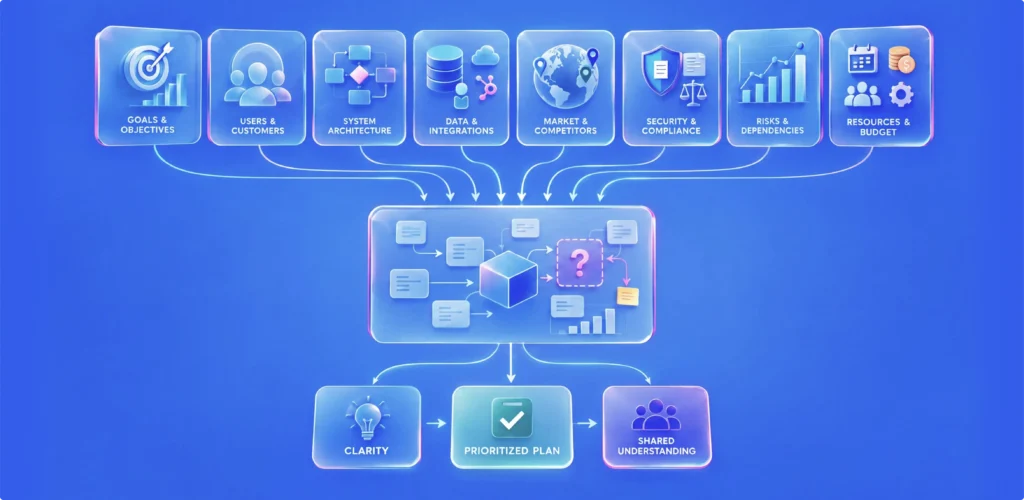
You may also add any compliance context, whether that's healthcare data, financial records, or something narrower to your industry, along with whatever metrics you're already tracking. List the constraints you know about going in too: budget, timeline, an existing team whose skills the plan needs to fit, a platform you're already locked into.
None of this needs to be polished. Part of what a good discovery session does is show you exactly where the gaps in your own understanding are, and that's useful information on its own.
Not every feature deserves the same amount of scrutiny before development starts. A settings page that lets a user change their timezone carries almost no risk if it's built wrong the first time. But a billing workflow that miscalculates a proration, or an approval flow that lets the wrong role bypass a review step, may do real damage.
So, pick three to five workflows to validate in depth, and choose them by business impact, by how much uncertainty still surrounds them, and by what it costs if they fail once live.
For each workflow on this short list, write down who performs it, what triggers it, what a successful outcome looks like, and what happens when something goes wrong along the way.
Take a subscription upgrade as an example. On paper it's one button and one confirmation screen. Underneath, it touches a payment provider, a proration calculation, an entitlements table that decides which features the account unlocks, and an email or in-app notice confirming the change. If the discovery walks through what happens when the payment provider times out mid-charge, or when a user upgrades and downgrades twice in the same billing cycle, the SaaS technical requirements start writing themselves.
If you're building on top of something that already exists, discovery has to look at what's there before proposing what comes next. This means mapping system boundaries: which parts of the product are self-contained, which modules depend on each other, what the deployment model looks like today, and where you're relying on legacy components that resist change.
Teams sometimes build a custom solution for a problem a mature third-party tool already handles well, simply because nobody stopped to ask the question early enough. Other times the opposite happens: a team combines together several SaaS tools to patch a workflow that would run far better as one custom system. Neither mistake may be obvious from the outside, which is exactly why it needs to be tested during discovery.
The point is to write down the two or three real alternatives that were considered, why one was chosen over the others, and what constraint would change that decision later. UITOP built the entire backend for LogiCore, a warehouse and logistics platform, from a blank page, connecting shipment tracking, inventory, and multi-warehouse operations that had previously stayed across three or four disconnected tools. The architecture decisions made during that early stage, how data would sync in real time across regional warehouses, how the system would stay responsive under peak load, turned out to matter more to the final product than almost any single feature.
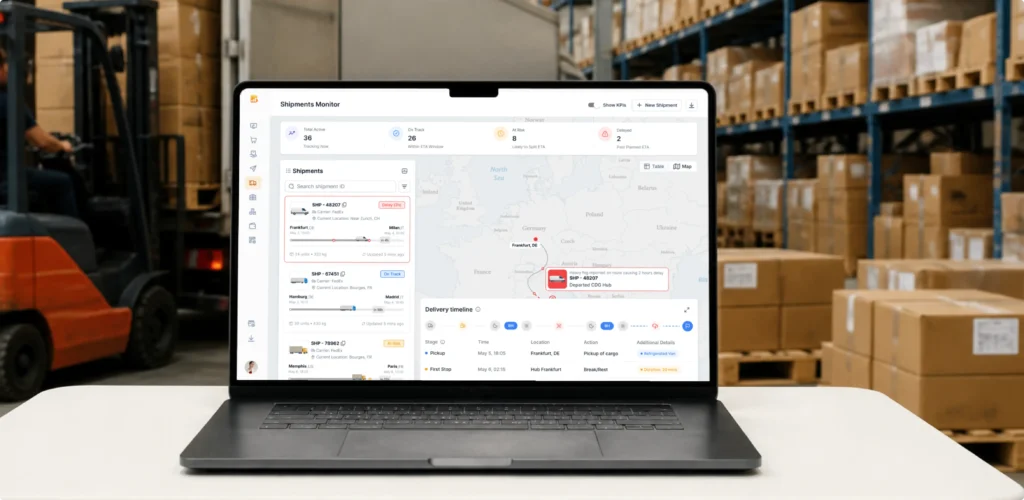
Data questions are postponed more often than any other part of discovery, and they're usually the ones that cost the most once postponed. Before development starts, you need a working answer to where the source of truth is for each major entity, what the data's lifecycle looks like from creation to deletion, how long it needs to be retained, and who actually owns it once it moves between systems.
If you're bringing over existing data, ask what state it's actually in. Duplicate records, inconsistent formats, and half-filled fields are the norm, and the volume of data you're migrating changes the plan significantly.
These decisions let you define what states your interface has to handle, what your reporting is able to show accurately, and how challenging your next integration turns out to be. The table below can help you in the process:
| Data question | Risk if left unanswered | How to validate it |
|---|---|---|
| Where is the source of truth? | Conflicting records across systems | Trace one record end to end through every system that touches it |
| What's the retention and deletion policy? | Compliance exposure, storage costs | Confirm against applicable regulation and business need |
| How clean is the data being migrated? | Failed imports, broken reporting | Run a sample migration against production-like data |
| What's the rollback plan? | Extended downtime during migration | Test a rollback on a non-production environment first |
Discovery also has to test each integration against the details that actually determine whether it works:
Our team at UITOP faced exactly this problem while building Pacioli, an accounting platform for a Canadian firm serving healthcare clients. An earlier attempt to sync with QuickBooks Desktop through a dedicated Windows server had already failed in production.
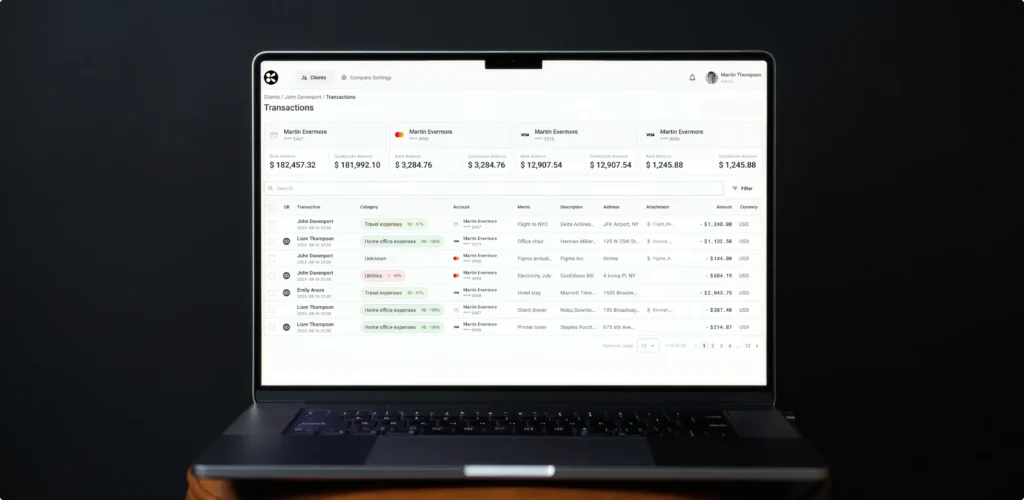
We replaced the path with a direct integration through Flinks, covering roughly 97% of Canadian financial institutions, and built a normalization layer underneath it so that live bank feeds and manually uploaded CSV files were processed through the exact same categorization logic.
So, the API documentation tells you what's supposed to happen. Discovery is where you find out what actually happens when the traffic gets heavy or the connection drops halfway through a sync. That’s why decisions about technical constraints that should shape the SaaS tech stack belong earlier in the process than some teams place them.


Check the technical risks before development starts
UITOP will review your architecture and integrations, so risky assumptions are tested before they affect scope or estimates.
Start discoverySecurity questions asked after launch tend to be questions asked too late. Discovery needs to cover data sensitivity classification, how authentication will work, how authorization decisions are made, and much more.
What discovery does is set a technical baseline: default to the narrowest permission a user needs rather than the widest one available, deny access by default rather than allow it, and check permissions on the server rather than trusting whatever the client sends. These three habits can let you catch a large share of the access-control problems that show up in SaaS products built without this baseline in place.
Tenant isolation deserves a specific mention. A database may fail if a query somewhere in the codebase forgets to filter by tenant, and this kind of mistake is rarely visible until a customer notices data that isn't theirs. Testing this during discovery is one of the cheaper checks on this list and one of the most expensive to skip.
Every SaaS pitch mentions scale, and almost none of them define what this word means for their specific product. Discovery has to explain this too:

If your SaaS product serves more than one organization, the tenant model isn't a detail you fill in during development. It determines how user roles are defined, how onboarding works for a new account, what admin actions are available and to whom, etc.
These decisions need to show up in two places at once: the interface a user sees, and the backend model underneath it. We treat this as a standard part of scalable SaaS product design and development, because a tenant model decided halfway through a build tends to require rework across both layers.
These two tools get confused constantly, and using the wrong one wastes time either way. A UX prototype tests whether a workflow makes sense to a real user:
A technical proof of concept tests whether an integration behaves the way it needs to, whether a performance target is achievable with a given approach, whether a new technology actually does what its documentation claims.
The choice between them comes down to what's actually uncertain. If you're not sure users will understand a new onboarding flow, build a clickable prototype and put it in front of real people.
If you're not sure a third-party API is able to handle your expected transaction volume, build a small proof of concept that hits the API under realistic load. A proof of concept for every feature on the list isn't a good use of the time discovery has. Reserve it for the assumptions that would be genuinely expensive to get wrong, and let discovery tell you which ones those are.
Everything discovery uncovers, confirmed assumptions, risks that are still open, dependencies on other teams or vendors, and non-functional requirements like performance and security targets, should feed directly into scope, sequencing, and a cost estimate.
An estimate is a range built on stated assumptions, and it's meant to shift as these assumptions are tested further during the build. A commitment is a promise to deliver specific scope by a specific date. Confusing the two is how projects end up in disputes that have nothing to do with the actual engineering.
UITOP treats this distinction as central to planning a custom web application, because a client who understands which numbers are firm and which are provisional makes far better decisions about sequencing than one who was handed a single number and told to trust it.
Not sure what your SaaS product needs before development?
We help clarify architecture, scope, and technical decisions before you commit resources.
Book a callA discovery process that ends without concrete outputs hasn't really finished. At minimum, you walk away with:
| Deliverable | Decision it supports | Owner | Acceptance signal |
|---|---|---|---|
| System context and architecture map | What gets built, what gets integrated | Technical lead | Stakeholders agree on boundaries |
| Integration map with risk notes | Which vendors and APIs are viable | Engineering | Each integration tested or explicitly flagged |
| Risk register | Where contingency belongs in the estimate | Project manager | Every risk has an owner and a next step |
| Non-functional requirements | Performance, security, and reliability targets | Product and engineering | Thresholds are specific and measurable |
| Phased scope and estimate | What gets built first, and for how much | Product owner | Estimate ranges tied to named assumptions |
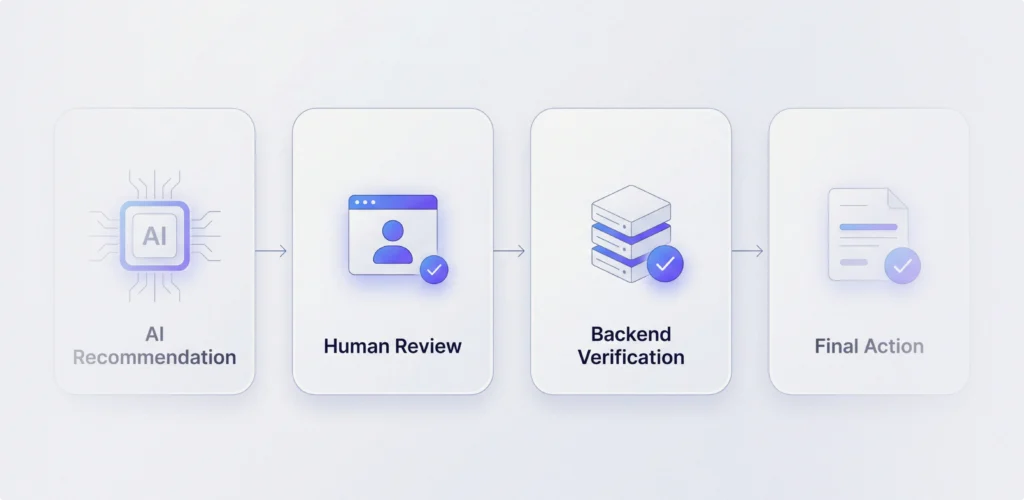
Discovery should end when the project has reached a specific, testable point:
Complete enough means the expensive unknowns have been dealt with and the cheap ones have been left for later, on purpose.
It also helps to name, out loud, which unresolved questions are being deferred and why. A risk that's been discussed and consciously postponed is a very different thing from one that got missed. The first is a plan. The second is the beginning of a rewrite six months from now.
The point of technical discovery was never to predict the entire project in advance. Nobody is capable of that, and any process that claims otherwise is overselling itself. The actual goal is narrower and more useful: pull the expensive unknowns forward, where they're cheap to test, instead of letting them surface halfway through a build, where they're expensive to fix.
Product decisions, UX decisions, and technical decisions all need to connect to each other before development starts, because a product decision made without knowing the technical cost, or a technical decision made without understanding the workflow it's supposed to support, is how teams end up rebuilding the same feature twice.
If your team is heading toward a build and hasn't gone through this kind of the process yet, our team at UITOP runs technical discovery as a structured, standalone engagement. We map the architecture, test the integrations and data assumptions that carry the most risk, and turn the findings into a phased scope and an estimate your stakeholders are actually able to stand behind. Get in touch with us to talk through where your product stands and what a discovery phase would look like for it.
Technical discovery is the stage where your team investigates whether the proposed product can be delivered under the constraints that already exist. If the product depends on an external API, for example, the team should verify how the API actually behaves under the use case you have in mind. Documentation alone may not answer questions about rate limits or authentication flows, especially once several user accounts are involved. By the end of discovery, you should have a much better picture of what is technically understood and which questions still carry risk.
Product discovery is concerned with whether the product idea is worth pursuing from the user’s perspective. You are trying to understand the problem well enough to decide what the product should solve and whether people care enough about the problem for the solution to matter.
Technical discovery begins from a different question: if this is the product we intend to create, what does it take to make it viable? Your team looks at the technical assumptions behind the proposed solution and tests the ones that could affect scope or cost.
There is no standard duration because discovery effort depends on what the team has to verify. If your product relies on several third-party systems or inherits an older codebase, the investigation often takes longer because more assumptions have to be tested.
The depth of discovery also changes with business risk. A billing platform with regulated financial data deserves a different level of investigation. In this case, the team may have to validate security requirements alongside data flows and integration behavior before an estimate is worth trusting.
It is usually more useful to define discovery by the questions that must be answered than by a fixed number of days. Once these questions are resolved well enough for the team to make informed technical decisions, development planning becomes much more credible.
The deliverables should show what the team learned and how these findings affect the proposed product. A system architecture map is usually part of this because it records the major components and the relationships between them. An integration map is useful when the product depends on external services, particularly if any of these dependencies carry technical limits or unresolved questions.
If the team ran a prototype or proof of concept, its findings should be documented in enough detail that later decisions can trace back to what was actually tested. Discovery usually ends with a phased scope and an estimate that states its assumptions openly.
Yes. The main improvement comes from reducing the number of hidden assumptions inside the estimate.
Imagine your SaaS product depends on a third-party system that appears straightforward from its documentation. An estimate created before anyone tests the integration will treat that dependency as relatively predictable. If discovery shows that the API has restrictions your planned workflow did not account for, the team can change the technical approach before these restrictions start affecting development.